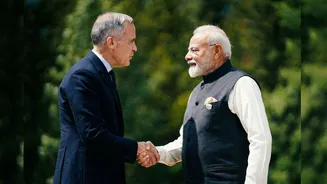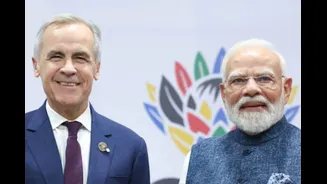







Canada’s latest public assessment that there is no evidence of ongoing foreign interference in the country comes just ahead of Prime Minister Mark Carney’s visit to India, marking what could be a significant
diplomatic recalibration between Ottawa and New Delhi. Senior Canadian officials have reportedly conveyed that they are convinced of India’s stated position that it has not engaged in active interference on Canadian soil. The shift in tone is being read in New Delhi as validation of its consistent denials and as a signal of renewed political pragmatism in Ottawa, despite domestic pressures stemming from sections of the diaspora.
For months, tensions between the two countries were amplified by allegations of extortion, threats and violent activities linked to Indian actors. However, recent Canadian statements suggesting that such activities are not continuing are being interpreted by Indian intelligence sources as an implicit acknowledgment that earlier claims may not have been backed by conclusive evidence. While Ottawa has not formally reversed its previous positions, officials on both sides appear to be lowering the temperature. The reactivation of structured communication between national security advisers is seen as evidence that quiet backchannel mechanisms are functioning again, creating space for a broader diplomatic reset.
The apparent de-escalation is allowing both governments to refocus on areas of shared interest. Carney’s visit is expected to prioritise trade and technology partnerships, including cooperation in artificial intelligence, quantum research, clean energy and critical minerals. Discussions are also likely to touch on nuclear collaboration and a coordinated approach to the Indo-Pacific, where both countries have strategic interests. Commercial considerations appear to be playing a central role in shaping this renewed engagement, underscoring the economic costs of prolonged diplomatic friction.
At the same time, Indian officials are expected to use the visit to press for firmer Canadian action against pro-Khalistan networks operating from Canadian territory. Indian intelligence assessments maintain that the so-called Khalistan ecosystem in Canada does not represent a broad-based separatist movement but rather a networked influence structure that leverages diaspora freedoms, political lobbying and digital outreach. They argue that the majority of Canadian Sikhs are economically integrated and do not support separatism, even as a small but vocal group of activists has sought to amplify its agenda through symbolic referendums and advocacy campaigns. If managed carefully, Carney’s trip could mark the beginning of a more stable, interest-driven phase in India–Canada relations.