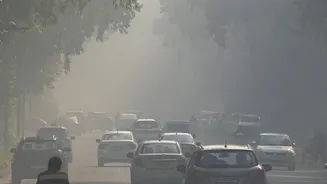

Planning to drive down to Delhi? You may want to check if your vehicle has a BS-VI engine as the Capital’s stringent anti-pollution norms, adopted by the Delhi government, will kick in from Thursday. The
rules also mean that fuel stations will not serve vehicles that do not have a valid PUC certificate.
The move to only allow cars with BS-VI engines could affect 12 lakh vehicles entering Delhi from Gurugram, Ghaziabad, Faridabad and Noida. Over four lakh vehicles from Noida, two lakh from Gurugram, and 5.5 lakh from Ghaziabad will be prohibited from entering the national capital, according to data available. Delhi has already installed automatic number plate recognition cameras at fuel stations to detect vehicles that do not have valid PUC (Pollution Under Control) certificates.
The measures, announced by Delhi’s environment minister Manjinder Singh Sirsa on Tuesday, will stay in place till Stage IV of the Graded Response Action Plan (GRAP) is in force in the national capital.
The move comes amid the Capital’s efforts to battle deadly smog and air pollution—a winter ritual. Every season, as temperatures dip, the pollutants—which linger near the surface—are trapped, leading to a severe deterioration in air quality. In areas with dense traffic, vehicles account for as much as 40 per cent of particulate pollution. Officials argue that curbing the movement of high-emission vehicles during periods of extreme pollution is essential to lower pollution levels and protect public health.
As many as 580 police officers will be assigned to conduct vehicle inspections, supported by 37 enforcement vans positioned across 126 checkpoints. In addition, teams from the Transport Department, Municipal Corporation and Food Department will be posted at petrol pumps to ensure compliance.
A dense blanket of hazardous smog enveloped several parts of the national capital on Thursday, with areas such as Najafgarh witnessing low visibility as a lingering haze hovered over streets and neighbourhoods. Air quality readings from the Central Pollution Control Board’s Sameer app showed Delhi’s AQI at 356 at 6am, placing it firmly in the ‘very poor’ category.
Anand Vihar recorded the highest AQI at 415 in the ‘severe’ category, followed closely by Vivek Vihar (410), Jahangirpuri (405), Rohini (400), ITO (399), Mundka (398) and Ashok Vihar (395). The Air Quality Index (AQI) in Najafgarh was recorded at 284, placing it in the ‘poor’ category.
The Delhi government has also directed private offices in the national capital to operate with a maximum of 50 per cent staff to ensure fewer vehicles are on the roads.