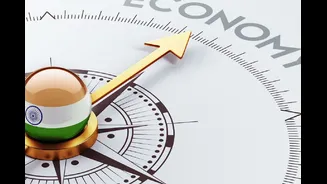

India’s economy continues to strengthen, officially becoming the fourth-largest in the world, leapfrogging Japan in the global GDP rankings. With sustained growth, experts and international agencies now
say India is on track to become the third-largest economy within the next few years.
According to the latest data, India’s GDP stands at approximately $4.18 trillion, placing it just behind Germany, which has an economy of around $5 trillion. Analysts project that India could surpass Germany by 2027–28, setting the stage for it to claim the third position globally.
In 2025, the United States remains the world’s largest economy with a GDP exceeding $30.6 trillion, followed by China at about $19.4 trillion, a figure that continues to grow rapidly. Germany is currently third, India fourth and Japan has slipped to fifth. Other economies in the top 10 include the United Kingdom, France, Italy, Canada and Brazil.
International organisations like the International Monetary Fund (IMF) and S&P Global forecast that India could rise to the third spot by 2030–31, with its GDP projected to reach $7.3 trillion. Some long-term estimates, including a PwC report, even suggest India could rank second by 2050, behind China and ahead of the United States.
While India climbs the global rankings, neighbouring Pakistan remains outside the top 10 economies. With a GDP of around $410 billion, Pakistan currently ranks near 42nd globally, according to the World Bank. Its growth rate, estimated at 2-3%, is markedly lower than India’s daily expanding footprint.
India’s rapid ascent is attributed to multiple structural factors:
- A young and growing workforce
- A digital revolution transforming commerce and governance
- Expansion in manufacturing and services
- Strong foreign direct investment (FDI) inflows
- Government initiatives such as Make in India, Atmanirbhar Bharat, and hefty investments in infrastructure
In 2025, India recorded an annual GDP growth of 8.2%, among the highest globally, fuelled by robust domestic demand and resilient supply chains.
Economists say India’s climb will bring tangible benefits to its population. Job creation is expected to accelerate, wages could rise and inflationary pressures may ease as the rupee strengthens, reducing import costs. Improved credit conditions may also make loans for homes and vehicles more affordable. India’s startup ecosystem, now home to numerous unicorns, continues to offer new opportunities to younger professionals.
Despite the optimism, challenges remain. Rising inflation, unemployment and climate change are key issues that the government must address to ensure equitable growth across regions and communities.