








India has spent years widening its network of overseas oil suppliers, expanding refining capacity and opening more offshore acreage for exploration. Yet one weakness has remained largely unchanged: the
country still produces only a small share of the crude oil and natural gas it consumes.
The Rs 84,084 crore Samudra Manthan
– National Offshore Exploration Scheme is the government’s attempt to address that gap at its source.Approved by the Union Cabinet on Friday for implementation till FY2030-31, the programme will support seismic surveys, exploratory drilling and offshore infrastructure across India’s maritime territory. The aim is not to replace imports immediately, but to create a larger pipeline of domestic oil and gas discoveries that could strengthen energy security over the coming decade.
Why Is India Making Such A Large Offshore Push Now?
India’s vulnerability became particularly evident during the recent conflict in West Asia, when uncertainty around the Strait of Hormuz raised concerns over oil and gas supplies.
Nearly 90% of India’s crude oil requirement is met through imports, while imported LNG accounts for around half of natural gas consumption. This makes India vulnerable to supply disruptions, geopolitical shocks and volatility in global energy markets.
The problem is likely to grow as consumption rises.
Sourav Mitra, Partner – Oil and Gas at Grant Thornton Bharat, told TOI that the International Energy Agency expects India’s oil demand to reach 6.66 million barrels per day by 2030. “In other words, refining capacity is not the principal constraint; domestic feedstock availability is. The demand gap is structural,” Mitra said.
India has 258.1 million tonnes per annum of refining capacity, according to data cited by TOI, but domestic crude oil production stood at only 28.71 million tonnes in FY2025-26. Crude import dependence reached 88.7% during the year.
Domestic production has also continued to fall. It declined by 2.8% in FY2025-26 and by another 4.2% year-on-year during April-May 2026, according to figures cited by Mitra.
What Exactly Will Samudra Manthan Do?
The programme is designed to improve India’s chances of finding commercially usable oil and gas beneath the seabed. It includes large-scale acquisition, processing and interpretation of seismic data to identify areas where hydrocarbons may be present.
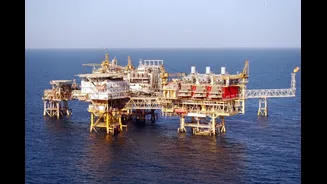
The scheme will also support exploratory drilling in deepwater and ultra-deepwater regions, along with scientific drilling in frontier basins that have not yet been adequately explored.
It provides for common offshore production and evacuation infrastructure, besides an integrated oil and gas manufacturing and services zone. Technology adoption, digital programme management, capacity building, skill development and international collaboration are also part of the programme.
Prime Minister Narendra Modi had announced the National Deep Water Exploration Mission during his Independence Day address on August 15, 2025.
“To make the country developed, we are now moving towards ‘Samudra Manthan’ (churning of the ocean). Taking forward our Samudra Manthan, we want to work in a mission mode towards finding oil reserves, gas reserves under the sea and hence India is going to start the National Deep Water Exploration Mission,” he said.
Union Minister Ashwini Vaishnaw later described it as “a very ambitious programme” and said India had “significant reserves of hydrocarbons, including oil and natural gas” within its Exclusive Economic Zone.
Why Better Data Could Be As Important As More Drilling
India has already opened large areas for exploration. As of July 2026, 172 blocks covering nearly 3.8 lakh square kilometres had been awarded under the Open Acreage Licensing Programme, with investment commitments exceeding $4.3 billion, according to TOI.
Around 99% of offshore areas earlier classified as “No-Go” zones have also been opened.
But acreage alone does not guarantee discoveries. Offshore drilling is costly, technologically complex and exposed to geological uncertainty. Better geological data can help companies assess exploration prospects before committing capital.
Rajnish Gupta, Partner, Tax and Economic Policy Group at EY India, told TOI that seismic surveys and exploratory well logs could help de-risk exploration, while shared production and evacuation infrastructure could lower the breakeven for blocks that might otherwise be considered marginal.
“If this exploration push turns up compelling results or if it opens up even new basins or play, that could trigger a wave of private and international investment well beyond the scheme’s own outlay,” Gupta said.
The programme is therefore also being seen as an attempt to attract private and international investment into India’s offshore basins.
How Much Oil And Gas Could India Gain?
The government expects the scheme to add more than 600 million metric tonnes of oil equivalent, or MMTOE, to India’s reserves.
That figure, however, should not be read as the amount of oil India will immediately produce. MMTOE combines oil and gas into a common unit, and the scheme has not specified how much of the projected addition would be oil, how much would be gas or when it would become available.
Prashant Vasisht, senior vice-president and co-group head at ICRA, told ThePrint that the programme could add annual production of 10-15 million tonnes of oil equivalent.
“The scheme aims to add incremental annual production of 10-15 million tonnes of oil equivalent which would reduce the dependence on imports of oil and gas but only to the extent of 3-5 percent,” he said.
Why The Andaman Basin Matters
Recent exploration in the Andaman Basin has given the offshore push additional momentum.
State-run Oil India Ltd reported hydrocarbons in two of three exploratory wells drilled near Vijayapuram in June, after finding natural gas in another well the previous year.
The discoveries have not yet been established as commercially viable. However, according to ThePrint, they indicate the presence of a working petroleum system in the basin.
Will Samudra Manthan Cut Imports In The Near Term?
Not substantially. Offshore projects require seismic surveys, exploratory drilling, appraisal and infrastructure development before production can begin. That process can take several years even after hydrocarbons are found.
Kpler Lead Analyst Sumit Ritolia told TOI that India’s crude import dependence was unlikely to decline materially over the next five to 10 years because of the programme alone.
Its immediate contribution will therefore be to expand exploration and improve the information available about India’s offshore resources. Its long-term value will depend on whether those surveys and wells lead to commercially recoverable discoveries and how quickly they are brought into production.