
Two years after India’s first-ever solar observatory Aditya L1 was placed in a halo orbit in space, the Indian Space Research Organization (ISRO) has opened its first call for scientists, researchers to apply
for observation time on the spacecraft.
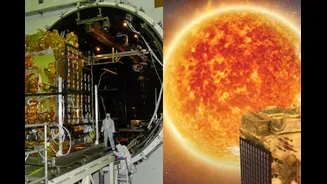
Launched on September 2, 2023 aboard a PSLV, Aditya L1 is India’s first dedicated space mission to study the Sun. After a series of maneuvers, the spacecraft was successfully inserted into a halo orbit around the first Lagrangian point (L1) in the Sun-Earth system on January 6, 2024 – over 1.5 million kilometres away from Earth. Although the spacecraft carries as many as seven payloads – four for remote sensing and three of in-situ measurements, ISRO has invited research proposals for only two of its instruments for the first observation cycle – the Visible Line Emission Coronagraph (VELC) and the Solar Ultraviolet Imaging Telescope (SUIT).
The observation window for the first cycle will open from April to June 2026.
Indian researchers, scientists and solar community residing and working in India and involved in scientific research in the field of solar and heliospheric astronomy can submit their proposals through the Aditya L1 Proposal Processing System hosted at the Indian Space Science Data Centre (ISSDC) by February 6. These proposals will be reviewed by the Aditya L1 Time Allocation Committee for scientific merit and technical feasibility.
Since Aditya L1 is operated in a pre-planned manner, so the researchers will not be allowed to be present at Mission Operations Complex when the observations are being undertaken, clarified ISRO. But the data will be released in the public domain via ISSDC immediately in the standard CDF (Common Data format) and FITS (Flexible Image Transport System) format upon generation. The space agency also highlighted that it may use and cite the published research based on Aditya L1 data in its own reports and publications.
The national space agency has already released over 23 TB of scientific data from the crucial mission in public domain, and several results have been published in international peer reviewed journals. However, it now plans to maximise the scientific return by inviting researchers to apply for permission to use the solar observation instruments for their scientific studies.
The position of Aditya L1 in the halo orbit around L1 offers scientists a unique vantage point for continuous, uninterrupted observations of the Sun, free from any eclipses or occultation. So, they can monitor the solar activity, and collect measurements of solar particles, and magnetic fields, free from the influence of Earth’s magnetosphere. While the remote sensing instruments observe different layers of the Sun, including the photosphere, chromosphere, and corona, using various wavelengths of electromagnetic radiation, the in-situ payloads, including particle detectors and magnetometers, collect data on the local space environment.