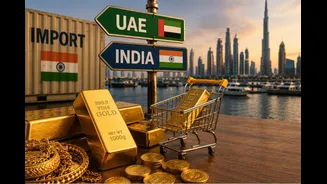








Prime Minister Narendra Modi’s appeal to Indians to avoid unnecessary gold purchases has come against the backdrop of a sharp rise in the country’s gold import bill, and a striking surge in shipments from
the United Arab Emirates, a report has claimed.
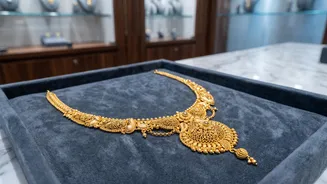
According to an analysis by the Global Trade Research Initiative (GTRI), cited by The Economic Times, India’s gold-bar imports rose 47.1 per cent to $11.01 billion in April-June 2026, from $7.49 billion in the same period last year. The increase came even after the government raised the import duty on gold from 6 per cent to 15 per cent on May 13. Higher international gold prices also contributed to the increase in the value of imports.
However, the country-wise figures reveal a more unusual trend. Imports from the UAE have risen dramatically even as shipments from the rest of the world have moved in the opposite direction.
UAE Gold Imports Surge 175% In June
India imported gold worth $649.4 million from the UAE in June 2026, a 175.2 per cent increase from $235.9 million in June 2025, according to GTRI data cited by the report.
At the same time, gold imports from the rest of the world fell 17.7 per cent, from $1.60 billion to $1.32 billion.
The divergence was significant.
UAE shipments increased by $413.5 million during the month, while imports from all other countries combined declined by $284.1 million.
As a result, the UAE’s share of India’s monthly gold imports jumped to 33 per cent in June 2026, from 12.8 per cent a year earlier.
The trend was also visible across the April-June quarter.
Gold imports from the UAE more than doubled, rising 124.8 per cent to $3.14 billion from $1.40 billion a year earlier. Imports from the rest of the world increased 29.3 per cent, from $6.09 billion to $7.87 billion.
India’s total gold imports rose by $3.53 billion during the quarter, with the UAE alone accounting for $1.74 billion – nearly half of the increase.
The UAE’s share of India’s quarterly gold imports consequently rose from 18.7 per cent in April-June 2025 to 28.5 per cent in April-June 2026.
GTRI said the figures showed that the UAE was “not merely another supplier” but had become a “principal driver” of the increase in India’s gold import bill, the report mentioned.
Preferential Tariff Under India-UAE FTA In Focus
The surge has brought the preferential tariff available under the India-UAE FTA into focus.
The UAE is not a gold-producing country. Under the trade agreement, gold that meets the stipulated rules of origin can enter India at a 14 per cent tariff, compared with the normal 15 per cent rate.
GTRI founder Ajay Srivastava has argued that the one-percentage-point difference can be significant in bullion trading because gold is a high-value commodity with relatively low margins.
According to the analysis, the concession could encourage importers to “source or route more gold through the UAE.”
GTRI has consequently called for the government to review the one-percentage-point concession and strictly enforce the FTA’s rules of origin.
The concern is whether gold originating in third countries could potentially be routed through the UAE to take advantage of the preferential tariff.
However, the data itself does not establish that third-country gold is being diverted through the UAE.
Rather, the unusually rapid growth in UAE shipments has raised the question of whether the tariff concession is contributing to the pattern.
GTRI has also called for scrutiny of gold and silver import concessions extended to the UAE under the FTA.
PM Modi’s ‘Don’t Buy Gold’ Appeal
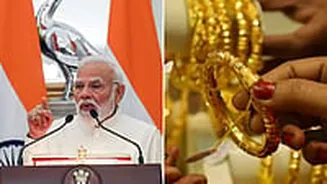
The UAE import surge assumes greater significance because of Prime Minister Narendra Modi’s renewed appeal to Indians on September 1 to avoid unnecessary gold purchases.
In a message, the Prime Minister urged people to refrain from buying gold unless necessary, as part of a broader call for self-reliance and greater focus on domestically produced goods.
PM Modi’s appeal was linked to his push for swadeshi and self-reliance amid external economic pressures.
In this context, the GTRI has questioned whether the continued tariff concession under the India-UAE FTA sits comfortably with the government’s objective of moderating gold imports.
“At a time when the Prime Minister is asking citizens to avoid unnecessary gold purchases, continuing a tariff concession that may be accelerating imports appears inconsistent,” the GTRI analysis said, according to The Economic Times.
The argument is therefore not simply about consumers buying less gold. It also raises questions about the policy framework governing how gold enters India.
Gold Prices Fall As Import Bill Remains Under Pressure
The latest import data also comes as domestic gold prices have been under pressure.
According to news agency PTI, gold prices in the national capital fell Rs 2,100 to Rs 1,56,100 per 10 grams on Wednesday, extending their losing streak to six sessions.
The metal has lost Rs 11,000 over those six trading sessions from Rs 1,67,100 on August 25.
The latest price was also around a three-week low, with gold last seen near those levels on August 14, when it was quoted at Rs 1,56,200 per 10 grams.
“Precious metals remained under heavy selling pressure on Wednesday, with spot gold falling to its lowest level in more than three weeks,” Saumil Gandhi, Senior Analyst of Commodities at HDFC Securities, said, according to PTI.
Silver also declined sharply, falling Rs 5,000 to Rs 2,35,500 per kg, its lowest level in two weeks.
September Imports May See Impact
The impact of PM Modi’s appeal could become clearer in the coming weeks.
The Economic Times reported that India’s gold imports could fall around 15 per cent in September following the Prime Minister’s renewed appeal.
India Bullion & Jewellers Association national secretary Surendra Mehta said trade estimates indicated that around 45 tonnes of gold were imported in August and that September imports were expected to decline by 15 per cent.
That could test whether the government’s call translates into weaker fresh demand ahead of the festive season.