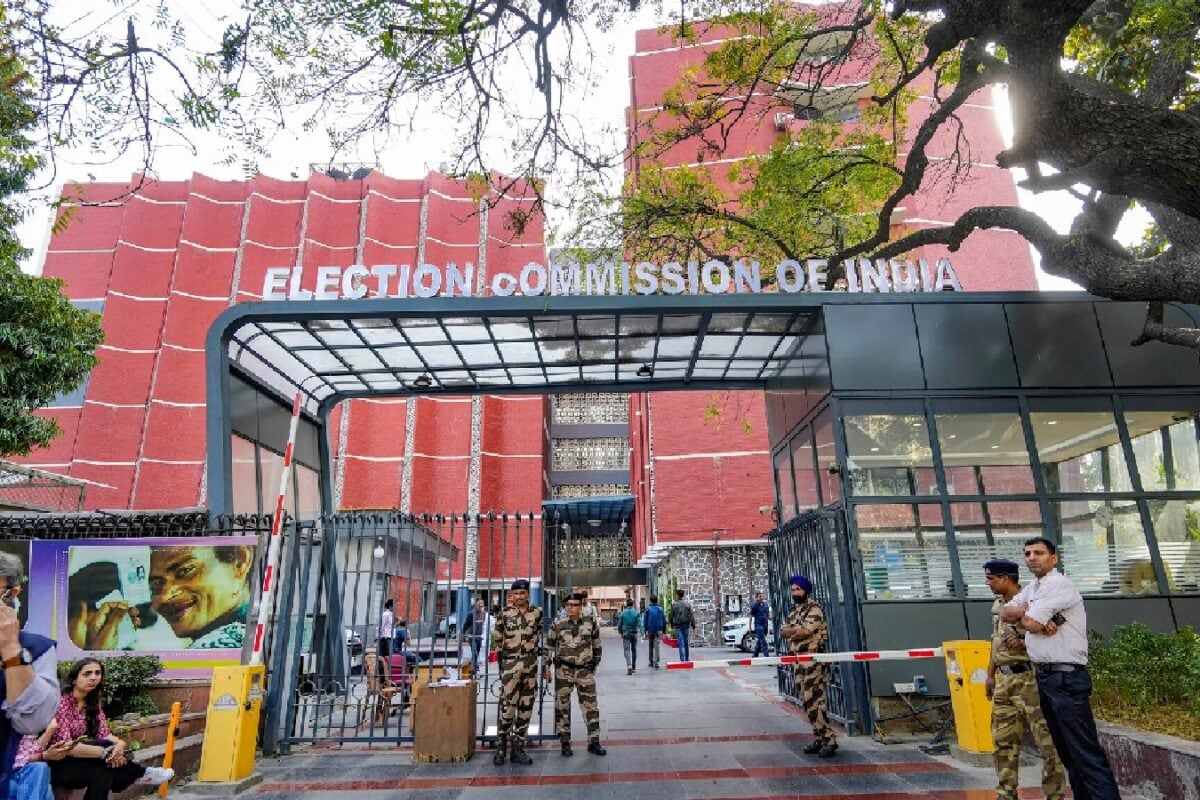







The Election Commission of India (EC) has removed the SpECal Intensive Revision (SIR)-related declaration from the online version of Form 6, the statutory application used by new voters to register themselves,
even in states where the electoral roll revision exercise is still underway.
According to The Indian Express, the declaration, which sought details of whether an applicant or their parents or grandparents figured in an earlier electoral roll, will now be submitted as a separate document on the ECNet portal. The move effectively reverses the commission’s earlier dECsion to display the SIR declaration as part of the online Form 6 application.
The latest change follows sustained objections by Election Commissioners Sukhbir Singh Sandhu and Vivek Joshi, who had questioned the legal basis for incorporating the additional declaration into Form 6. The Indian Express had reported that the two commissioners had raised objections to several dECsions and procedures adopted by the poll panel over the past 10 months.
In an affidavit filed before the Supreme Court on October 26, the EC said its Electoral Roll (ER) Division had dECded on October 21 to separate the two documents. The commission maintained that Form 6 itself had never been amended, but acknowledged that the way the declaration was displayed on the online platform could create the impression that the statutory form had been modified.
WHAT WAS THE DISPUTE OVER FORM 6?
Form 6 is the prescribed application used by eligible citizens to seek inclusion in the electoral roll. It is governed by Rule 13 of the Registration of Electors Rules, 1960.
The controversy began when the EC introduced an additional declaration for new voter applicants during the SIR exercise in Bihar in June 2025. The declaration, also referred to as Annexure D, sought information about the applicant’s or their family’s presence in an earlier electoral roll.
When the SIR was subsequently expanded, the declaration appeared on the ECNet portal between Sections J and K of the online Form 6 application.
Applicants were required to select one of three options: whether their own name appeared in the electoral roll during the previous SIR, whether the name of a parent or grandparent appeared in that roll, or whether neither their name nor that of their parents appeared in it.
The declaration was mandatory for applicants using the online platform, who could not proceed with their application without responding to it.
The central issue was whether the Election Commission could introduce such an additional requirement within a statutory form without formally amending it.
Under the existing legal framework, Form 6 is prescribed under the Registration of Electors Rules, 1960. The power to amend these rules rests with the Union government, after consultation with the Election Commission.
WHY DID TWO ELECTION COMMISSIONERS OBJECT?
The Indian Express reported on September 23 that Election Commissioners Sukhbir Singh Sandhu and Vivek Joshi had raised objections to the additional declaration being made mandatory alongside Form 6.
Joshi had written on May 16 that such a change could not be made without a legal amendment to the prescribed form. Sandhu agreed with the objection on May 19 and, in a subsequent note dated August 13, described the move as “unauthorised/illegal”, calling for its immediate removal.
Despite these objections, the additional declaration appeared on the online application in July and remained there during the initial stages of the controversy.
The EC’s first response, issued on September 23, did not specifically address the Form 6 issue. It maintained that all its actions were in accordance with the law and described the commissioners’ objections as operational queries or inputs raised during the drafting process.
On September 26, following a meeting of the full commission, the EC said the declaration attached to Form 6 for SIR had been upheld by the Supreme Court. It also said that the forms prescribed under the Registration of Electors Rules, 1960, would be used during non-SIR periods.
Consequently, the additional declaration was removed from online Form 6 in states where the SIR exercise had concluded, but continued to appear in states where the revision was still underway.
WHAT DID THE SUPREME COURT SAY?
The issue also came up before the Supreme Court, which clarified during proceedings in October that it had neither approved nor disapproved the modified version of Form 6.
The EC subsequently filed its counter-affidavit on October 26, explaining why the declaration had initially been displayed alongside the statutory form.
According to the commission, combining the two documents allowed applicants to complete the process using a single one-time password (OTP) and one electronic signature, instead of having to authenticate two separate submissions. However, the commission acknowledged that the manner in which the declaration was displayed on the online platform could be interpreted as an amendment to Form 6.
It said the Electoral Roll Division had therefore decided on October 21 to make the online application a two-part process, comprising the statutory Form 6 and a separate SIR declaration, similar to the arrangement followed for physical applications.
The EC reiterated that Form 6 could only be amended by the Union government.
WHAT CHANGES FOR NEW VOTERS?
With the latest change, applicants will no longer see the SIR declaration incorporated within the online Form 6 application. Instead, the statutory form and the additional SIR declaration will be presented separately.
The distinction is important because the commission has maintained that the declaration is a separate requirement associated with the SIR exercise and not an amendment to the statutory voter enrolment form.
The latest decision also marks the completion of a reversal that began after the objections raised by the two election commissioners came into focus.
The Form 6 issue is part of a wider series of disagreements within the Election Commission over its functioning, the management of electoral rolls and the centralisation of its digital systems. Sandhu and Joshi raised objections on at least 14 occasions over 10 months.
In the weeks following those disclosures, the commission also announced changes concerning its internal meetings, approval of new IT systems, audit of the ECINet platform and the powers of election officials handling electoral roll-related work.