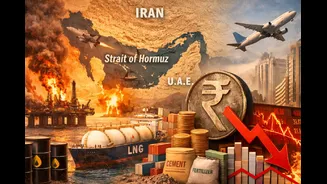










The sharp escalation of tensions in West Asia has pushed global crude oil prices above $115 per barrel, raising concerns about the economic fallout for large energy importers such as India. The situation
has become more serious amid fears of disruption or even closure of the Strait of Hormuz, one of the world’s most critical energy transit routes.
For India, which imports more than 80% of its crude oil requirements, oil price shocks are among the fastest channels through which geopolitical tensions affect the economy.
Why Strait of Hormuz Matters For India
The Strait of Hormuz is a narrow but extremely strategic waterway connecting the Persian Gulf with global markets. Nearly 20% of global crude oil flows and about 30% of liquefied natural gas (LNG) trade pass through this route.
India is particularly vulnerable because more than half of its crude oil imports transit through the Strait of Hormuz. Any disruption, even if temporary, can tighten global supply, push prices sharply higher and create uncertainty in energy markets.
A prolonged disruption could therefore pose risks to India’s energy security and import bill.
Pressure On Current Account And Rupee
A sustained rise in crude oil prices typically widens India’s current account deficit because the country has to spend more dollars to import energy.
A higher import bill can put pressure on the Indian rupee, particularly if foreign investors reduce exposure to emerging markets amid global uncertainty.
A weaker rupee, in turn, makes imports even more expensive, creating a feedback loop that can further aggravate inflationary pressures.
The Indian rupee on Monday declined by 46 paise to hit a fresh all-time low of 92.28 against the US dollar, amid the escalating Iran-US war that pushed crude oil prices above $115 per barrel. A big surge in FII outflows and a crash at the domestic equity market in morning trade put further pressure in the local unit, forex traders said.
Market Impact: Oil Shock And Equity Volatility
Financial markets tend to react quickly to oil shocks. Sectors that depend heavily on fuel or petrochemical inputs are usually the most vulnerable.
Aviation companies face rising fuel costs, while sectors such as paints, chemicals and cement may see margin pressure due to higher input prices.
V K Vijayakumar, Chief Investment Strategist at Geojit Investments Limited, said, “Brent crude has spiked above $115 delivering a big oil shock to economies and markets. Big oil importers like India will be hit hard if the West Asian conflict lingers long and crude price remains high. The market will price-in the economic consequences of this oil shock. Inflation will certainly move up whether the oil price hike is passed on to consumers or not.”
On March 9, Indian equities witnessed a sharp and broad-based sell-off, with all major indices ending deep in the red amid rising global risk aversion due to the intensifying Iran-US-Israel war.
As of 9:45 am, the Nifty 50 declined 2.84% to close at 23,756.20, slipping below the 24,000 mark, while the Bank Nifty plunged 3.93% to 55,511, leading losses among key indices. The BSE Sensex also declined 2,178 points or 2.81% to trade at 76,682.65. The fall reflects heavy selling in financial stocks and rising volatility in global markets.
Immediate Impact: Higher Inflation Pressure
Oil is one of the most immediate transmission channels for global shocks into the Indian economy. A sharp increase in crude prices raises input costs across sectors, especially transportation, manufacturing and logistics.
Higher energy costs eventually feed into consumer prices. Even if the government chooses not to pass on the entire increase to consumers through fuel prices, the fiscal burden rises through higher subsidies or reduced tax revenues.
Upasna Bhardwaj, Chief Economist at Kotak Mahindra Bank, said, “The higher crude oil prices, if they persist beyond a few weeks, will weigh on the current account deficit through higher oil imports, supply disruption on gas, fertilisers, and other inputs and trade with the Gulf countries. INR (Indian rupee) will come under significant pressure as FPIs (foreign portfolio investors) outflows may worsen.”
She added that higher input prices and a weaker rupee could weigh on the otherwise benign inflation outlook and keep the Monetary Policy Committee cautious on interest rate decisions.
But History Suggests Limited Long-Term Damage
Despite the immediate shock, past events suggest that oil spikes do not necessarily derail Indian equity markets unless they persist long enough to damage growth and macroeconomic stability.
Axis Asset Management noted in a recent report, “History shows that oil shocks alone have not derailed Indian equities unless they persist long enough to damage growth and monetary stability. During the Russia – Ukraine war in 2022, for example, Brent crude surged above $100 per barrel. Yet after an initial sell-off, the Nifty 50 still ended the year in positive territory.”
The Key Variable: Duration Of The Crisis
The ultimate economic impact will depend largely on how long the disruption lasts.
If crude prices remain elevated for an extended period or if the Strait of Hormuz faces prolonged disruption, India could face higher inflation, pressure on the rupee, and a widening current account deficit.
However, if geopolitical tensions ease quickly and energy supply routes remain open, the economic shock could remain temporary.