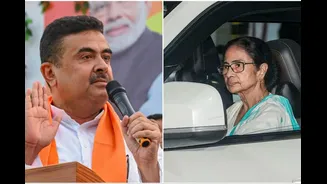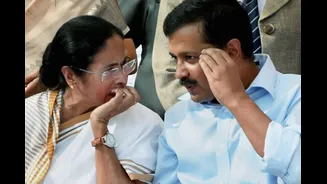







Months after defeating Aam Aadmi Party (AAP) chief Arvind Kejriwal in Delhi, the Bharatiya Janata Party (BJP) has now unseated Mamata Banerjee in Bengal, where the three-time chief minister lost her own
seat and watched her party fall well short of a majority.
Since she became West Bengal’s first woman chief minister in 2011, she remained politically dominant until Monday when BJP’s Suvendu Adhikari defeated her.
It was not the first time Adhikari has defeated Banerjee. He had also defeated her in Nandigram in 2021, but this time, the defeat is far more consequential as BJP is set to form the government.
BJP secured 207 seats on Monday, with Adhikari securing 73,917 votes—15,105 votes more than the 58,812 secured by the Trinamool Congress (TMC) chief.
In 2021, Adhikari had defeated Banerjee by over 1,950 votes. However, TMC’s 215-seat majority allowed her to return as chief minister after she won the Bhabanipur bypoll. In the main elections, Adhikari secured 1.10 lakh votes against Banerjee with 1.08 lakh votes. She later fought a bypoll from Bhabanipur and secured 85,263 votes.
In 2011, she did not contest the poll initially and was the Lok Sabha MP, elected in 2009. But to retain the chief minister’s post, she had to win an assembly bypoll within six months. Both times, in 2021 and 2011, Bhabanipur came to her rescue.
Bhabanipur had been Banerjee’s comfort seat since 2011. She won the elections with 73,635 votes in 2011 and 65,520 votes in 2016.
In 2011, she defeated Nandini Mukherjee with 54,213 vote margins, while in 2016 she won against Congress’ Deepa Dasmunshi with 25,301 votes. In 2021, she won against BJP’s Priyanka Tibrewal with 58,835 vote margins.
As Mamata Banerjee took oath for the office of the chief minister for the third consecutive term in West Bengal in 2021, she became the second woman in India to do so after Sheila Dikshit in Delhi.
BJP’s victory in West Bengal marks the first time the party is set to form a government in the state. This came just months after it swept the 2025 Delhi assembly polls—after a gap of almost three decades.
Kejriwal, a three-time MLA from New Delhi assembly, had also lost his seat in the 2025 elections with a margin of 4,000 votes. BJP’s Parvesh Sahib Singh Verma secured 30,088 votes against Kejriwal’s 25,999.
Kejriwal won the first election in 2013 from the seat, defeating then CM Dikshit with a margin of 25,846 votes as he secured 44,269 votes. This increased to 57,213 votes in 2015 and later dropped to 46,758 votes in 2020, with a victory margin of 21,697 votes. In 2025, Kejriwal not just lost his own seat but his Aam Aadmi Party also lost the majority after two landslide victories in 2015 and 2020. In both these years, AAP secured more than 60 seats in Delhi assembly out of total 70.
Next Punjab 🪷 https://t.co/UbHFK8VOCx
— BJP PUNJAB (@BJP4Punjab) May 4, 2026
With Delhi flipped and Bengal breached, BJP has now defeated two leaders who once appeared politically invincible in their political strongholds, shrinking the list of major opposition strongholds on India’s political map. The party has already signalled where it wants to expand next, with its Punjab unit posting ‘Next Punjab’ after Bengal’s win.