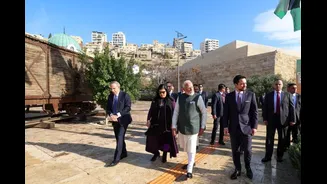

Prime Minister Narendra Modi concluded his two-day visit to Jordan on Tuesday, marking a significant milestone as India and Jordan celebrate 75 years of diplomatic relations.
The visit took place at the
invitation of King Abdullah II ibn Al Hussein, with both leaders acknowledging the depth of a relationship built on mutual trust, warmth and goodwill. Modi’s visit came at a time when bilateral ties span a wide range of sectors, including political engagement, trade, defence, security, culture, education and people-to-people exchanges.
During bilateral and expanded talks held in Amman on December 15, the two leaders agreed to further strengthen cooperation and work together as trusted partners in pursuit of their development goals. They reviewed progress under existing dialogue mechanisms and joint working groups, and reaffirmed their commitment to sustaining high-level interactions. The leaders also recalled their previous meetings in New York, Riyadh, Dubai and Italy, underlining continuity in engagement.
On the economic front, the two sides noted with satisfaction that bilateral trade stood at USD 2.3 billion in 2024, making India Jordan’s third-largest trading partner. They agreed to diversify the trade basket and convene the 11th Trade and Economic Joint Committee in the first half of 2026. The Jordan–India Business Forum, held alongside the visit, brought together senior business leaders to explore new avenues for trade and investment, while both sides also stressed cooperation in customs, logistics and regional connectivity.
Technology, education and digital transformation featured prominently in the discussions. India and Jordan agreed to deepen collaboration in digital public infrastructure, capacity building and governance, including through the India–Jordan Centre of Excellence in Information Technology. A letter of intent was signed to share India’s experience in digital public infrastructure, with both sides committing to a safe, secure and inclusive digital ecosystem.
Healthcare cooperation, including telemedicine and training of health professionals, was identified as a key pillar of engagement. The leaders also discussed expanding collaboration in agriculture, particularly in fertilisers and the exchange of technology to improve food security and efficiency. In the water sector, an MoU on water resources management was signed, focusing on water-saving technologies, climate adaptation and aquifer management.
Both sides also underscored the importance of green and sustainable development, welcoming the signing of an MoU on new and renewable energy. Cultural ties received a boost with the signing of a Cultural Exchange Programme for 2025–2029 and a twinning agreement between Petra and the Ellora Caves, aimed at cooperation in archaeology and cultural promotion.
At the multilateral level, King Abdullah II praised India’s leadership in initiatives such as the International Solar Alliance, Coalition for Disaster Resilient Infrastructure and the Global Biofuels Alliance, with Jordan expressing willingness to join these platforms.
At the conclusion of the visit, Prime Minister Modi thanked King Abdullah II for the warm hospitality extended to him and his delegation, while conveying best wishes for the continued prosperity of the Jordanian people.