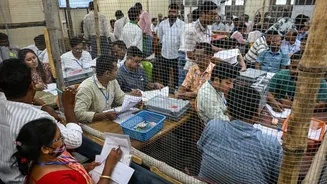








As counting of votes continues in West Bengal, the Bharatiya Janata Party (BJP) is steadily marching towards a thumping victory in the state. One of the most striking stories behind this surge is unfolding
in constituencies that were deeply impacted by the Special Intensive Revision (SIR) of electoral rolls. Check Live updates on West Bengal election results here.
What was initially projected as a routine clean-up exercise by the Election Commission of India may have turned into a decisive electoral factor. The SIR exercise led to a significant pruning of voter lists across several constituencies, particularly those where the electorate size dropped by more than 10 per cent compared to 2021. These 94 constituencies are now at the heart of the BJP’s remarkable performance.
The numbers tell a dramatic story. In 2021, the BJP had managed to win just 22 of these 94 seats, while the All India Trinamool Congress (TMC) dominated with 72. Fast forward to 2026, and the tables appear to have turned sharply. The BJP is now leading in 57 of these seats, while the TMC is ahead in just 34.
Many of these constituencies are located in districts like Murshidabad, Malda and North 24 Parganas — regions that have traditionally formed the backbone of the TMC’s electoral dominance. The SIR exercise, which removed a substantial number of names citing duplication, death, or migration, appears to have significantly altered voter dynamics in these areas.
Of over 60 lakh names that were under adjudication across West Bengal, around 11 lakh were from Murshidabad alone. After the SIR process, roughly six lakh names were retained, while about 4.5 lakh were deleted — the highest for any district in the state. The district, which has 22 assembly constituencies, also accounted for four of the seats with the highest deletions during the revision process. BJP’s Gouri Sankar Ghosh was leading over TMC’s Shaoni Singha Roy on the Murshidabad eat as counting of votes continued.
For the BJP, this shift reflects a successful political strategy. The party consistently framed the SIR as a necessary step to eliminate “bogus voters” and ensure electoral integrity. This messaging, combined with a broader campaign around identity and citizenship, seems to have resonated strongly in these constituencies, especially those near border regions.
At the same time, the issue sparked intense political mobilisation. The controversy around voter list revisions energised both sides, contributing to high turnout and heightened voter engagement. In such a charged atmosphere, the BJP appears to have gained more from the consolidation of its support base.
For the TMC, the trend raises uncomfortable questions. The party had strongly opposed the SIR exercise, alleging that it disproportionately affected its supporters. However, the counting trends suggest that it may not have been able to fully counter the narrative or mitigate its electoral impact on the ground.
What makes the BJP’s surge particularly significant is its concentration. These gains are clustered in constituencies where the electoral rolls saw the most dramatic changes.
As the results continue to unfold, one thing is increasingly clear: the SIR exercise has gone far beyond a technical revision. In this election, it has emerged as a pivotal factor, one that may have helped redraw the political map of West Bengal in favour of the BJP.