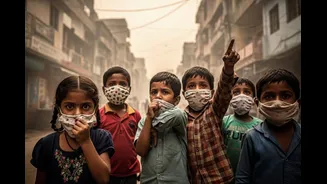

As air quality worsens, coughing, wheezing, and breathing trouble are driving a spike in medical tests across Indian cities, especially among school-going children. Top labs across Delhi-NCR are reporting
an increase in screening for asthma, allergies, and lung function, while health insurers are flagging a surge in hospitalisation claims linked to pollution-related illnesses.
Doctors and diagnostic chains say persistent cough, wheezing, breathlessness and allergy flare-ups are pushing both children and older adults to undergo pulmonary function tests, allergy profiles, IgE panels and cardiac evaluations. On the other side, insurers are recording a steep jump in respiratory claims.
Health insurance data underlines the scale of the problem. ManipalCigna Health Insurance says respiratory-related claims during winter have surged over four-fold between 2020 and 2024, while Policybazaar reports pollution-linked illnesses now account for more than eight per cent of all hospitalisation claims, with children forming the single-largest affected group. Together, lab and insurance data point to air pollution evolving from a seasonal irritant into a recurring public health burden. This year, during pre-Diwali, pollution-related claims rose by 7.6 per cent, whereas post-Diwali pollution claims (till September) rose by 9 per cent over previous years.
Children And Elderly Most Vulnerable
Diagnostic laboratories told News18 that the impact of poor air quality is most visible among children and the elderly. According to Dr Mayanka Lodha Seth, chief pathologist at Redcliffe Labs, “the worsening air quality, particularly during winter smog, is driving two key age groups to undergo a battery of diagnostic tests: children and the elderly”.
Children under 14 years are increasingly being tested for asthma, bronchitis and seasonal respiratory infections, undergoing pulmonary function tests, allergy profiles and complete blood counts. “Children, especially those under 14, are highly vulnerable because their lungs and immune systems are still developing,” Seth said. “They are undergoing pulmonary function tests, allergy profiles and complete blood count (CBC) due to rising cases of asthma, bronchitis and seasonal respiratory infections.”
At the other end of the age spectrum, adults over 60 years are also seeking more frequent evaluations. “Older adults aged 60 and above are also increasingly seeking evaluations such as ECGs,” she said, adding that chronic conditions such as COPD, cardiac disease, diabetes and weakened immunity heighten their vulnerability during high pollution periods.” While the trend cuts across genders, patients with a history of smoking, occupational exposure or pre-existing respiratory illness are reporting more severe symptoms.
Seasonal lab data back this pattern. Hinal Shah, consultant biochemist at Agilus Diagnostics’ Global Reference Lab, told News18 that laboratories consistently see higher respiratory-related testing between October and December compared to July to September, driven by “worsening air quality (AQI), temperature inversion, reduced dispersion of pollutants, and higher allergen load.”
Children between five and 15 years and adults over 60 years account for the bulk of this rise. “Children (5–15 years) present with recurrent cough, wheezing, allergic rhinitis and asthma exacerbations, while the elderly, especially those with pre-existing COPD, asthma or cardiac disease, undergo repeated or extended testing,” Shah said. While gender distribution remains broadly comparable, she noted a slight male predominance in adult testing, likely due to higher outdoor and occupational exposure.
According to the data shared by Tarun Bhamra, spokesperson at Orange Labs show that the rise is broad-based across age groups but most pronounced among younger children. “The most pronounced increase is seen among primary school–aged children (6–11 years), where allergy testing volumes grew 2.6 times from July–September to October–December,” he said, attributing this to increased outdoor exposure.
Individuals with asthma, allergies or compromised immunity are also undergoing more frequent and comprehensive testing during periods of poor air quality.
Urban And High-Traffic Regions See Sharper Spikes
Geography is emerging as a key driver of testing volumes. Large cities and industrial belts are witnessing sharper increases as winter inversion traps pollutants closer to the ground. According to Seth from Redcliffe Labs, regions such as Delhi-NCR, Gurugram, Noida, Ghaziabad and parts of Haryana and Punjab frequently record very poor AQI levels during winter, increasing exposure to PM2.5 and PM10 among schoolchildren, outdoor workers and older adults.
Similarly, Shah said the trend is “more pronounced in urban and peri-urban regions, particularly in high-traffic zones, industrial belts and cities with known seasonal deterioration in AQI”. Laboratories serving densely populated metros are seeing a much steeper rise in test volumes compared to semi-urban or rural areas, she added, with construction activity, biomass exposure and stubble burning worsening air quality further.
City-level diagnostics data show regional variation. From a diagnostics perspective, Bhamra from Orange Labs said its laboratories observed “an almost two-fold increase in allergy-related testing during October-December across Delhi-NCR, Mumbai, and Hyderabad,” while Bengaluru did not register a similar spike. “Notably, the increase in testing volumes in Hyderabad and Mumbai was higher than in Delhi-NCR on a comparable basis,” he said, suggesting heightened symptom awareness and proactive health-seeking behaviour in these cities amid rising AQI.
The testing trend, as per Agilus spokesperson, is more pronounced in urban and peri-urban regions, particularly in high-traffic zones, industrial belts and cities with known seasonal deterioration in AQI.
Respiratory Insurance Claims Jump Sharply In Winters
The clinical and diagnostic trends are mirrored in insurance data. ManipalCigna Health Insurance has reported a substantial rise in respiratory-related claims during winter, with its six-year analysis showing seasonal respiratory claims surged by over 321 per cent between 2020 and 2024.
Tier-2 and Tier-3 cities account for more than 84 per cent of all respiratory claims, indicating that pollution-linked illness is no longer confined to large metros. Among Tier-1 cities, Delhi-NCR contributes 6.5 per cent of respiratory claims, the highest share, followed by Bengaluru at 4.5 per cent and Mumbai at 4.2 per cent.
In 2024, respiratory conditions made up 18.8 per cent of all seasonal winter disease-related claims, led by COPD and asthma, followed by lung diseases caused by external agents and acute respiratory distress syndrome—conditions known to worsen during periods of high particulate and toxic pollutant exposure.
Policybazaar data reinforces the pattern. Children account for 43 per cent of pollution-linked health insurance claims, while respiratory and cardiac cases have pushed treatment costs up by 11 per cent. Pollution-related illnesses now form over eight per cent of all hospitalisation claims, with a sharp spike seen in the weeks following Diwali each year. Delhi leads in claim volumes, while Bengaluru and Hyderabad show higher claim ratios, and Tier-2 cities such as Jaipur, Lucknow and Indore are reporting rising case numbers.
As winter smog returns each year, the convergence of lab data and insurance claims is making the health cost of air pollution harder to ignore—with children and the elderly bearing the heaviest burden.