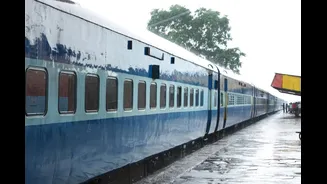

In most parts of India, railway tracks and national highways are carefully separated. Where they do meet, there are usually underpasses, flyovers, or railway overbridges to keep road traffic moving.
But
in Mangaluru, one stretch of National Highway-66 breaks this rule in an unusual way. Here, trains do not pass beside the highway or above it. Instead, they run straight through the middle of the road.
This rare crossing is located in Panambur, an industrial area along the NH-66 corridor that connects Mangaluru to Udupi. It is one of the few places in the country where a functioning railway line cuts across a busy national highway at ground level, bringing traffic to a complete halt whenever a train passes.
Why the Highway Is Cut by a Railway Line
The railway crossing exists primarily to serve Paradeep Phosphates Limited, a major fertiliser and chemical manufacturing unit located in Panambur. The factory relies on rail transport to move fertilisers and chemicals to various parts of South India.
Since there is no alternate railway alignment available from the factory to the main rail network, the goods train has to cross NH-66 directly.
Unlike passenger trains that operate on fixed schedules, these goods trains run only when there is a requirement to transport materials. This makes the crossing highly irregular, with trains passing through the highway only three or four days a week.
Complete Highway Closure During Train Movement
Whenever the goods train approaches the crossing, traffic on NH-66 is stopped completely. Barriers are lowered, vehicles are held on both sides, and the train moves slowly across the highway. The entire process usually takes no more than five minutes.
Because the train passes infrequently and the stoppage is brief, the closure has not triggered major public protests so far. Most commuters are aware of the crossing and accept the short delay as part of the local traffic pattern. However, the sudden halts can still catch motorists off guard, especially those unfamiliar with the area.
No Fixed Timing Adds to Uncertainty
One of the challenges with this crossing is the absence of a fixed schedule. The goods train can pass during the day or in the middle of the night, depending on operational needs. This unpredictability means that drivers cannot plan around the crossing in advance.
For long-distance travellers using NH-66, the unexpected halt can be frustrating, even if it lasts only a few minutes. Local residents say that while the delay is minor, the lack of information makes the crossing feel more disruptive than it actually is.
Ambulances and Emergency Vehicles Face Difficulties
While regular motorists may tolerate a five-minute stop, the situation becomes more complicated for emergency vehicles. Ambulances transporting patients have reportedly been forced to wait when the train crosses, leading to concerns about delays in medical emergencies.
Local voices have pointed out that even a short stoppage can have serious consequences when time is critical. This has renewed discussions about whether the current arrangement is sustainable in the long term, especially as traffic on NH-66 continues to increase.
Calls for an Overbridge or Underpass
Given the unique nature of the crossing, there is growing opinion that an engineering solution is needed. Many believe that constructing a railway overbridge or an underpass would eliminate the need to stop highway traffic altogether.
However, such infrastructure projects involve significant cost, land acquisition, and coordination between multiple agencies. Until a permanent solution is implemented, the goods train crossing remains an accepted but unusual feature of Mangaluru’s transport landscape.
A Rare Case on India’s Highway Network
Railway crossings on national highways are uncommon, and at-grade crossings on busy corridors like NH-66 are even rarer. Panambur’s crossing stands out as an exception shaped by industrial logistics rather than urban planning.
For now, the sight of a train cutting through the middle of a national highway remains a curiosity for many and a reminder of how industrial needs and transport networks sometimes intersect in unexpected ways.