
India’s fortunes in Test cricket have suffered a major dent amid their rise as T20I powerhouse. They are the current title holders of the ICC T20 World Cup and will be the favourites to defend the title when
the latest edition of the competition gets underway next month. Their fearless batters are setting the template, but in red-ball cricket, the team is struggling.
India, the runners-up of the first two editions of the ICC World Test Championship, are now even struggling to stay among the top-three teams of the ongoing cycle, having slipped to the sixth spot.
Impenetrable at home for almost 12 years, India have lost two of their last three Test series at home – 0-3 to New Zealand and 0-2 to South Africa. Unless there’s a dramatic change of fortunes, India may not qualify for the WTC final for the second time running.
So why the shift?
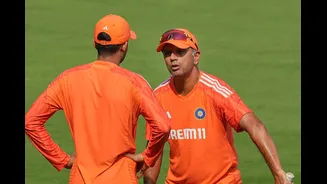
Batting legend and former head coach Rahul Dravid reckons that it’s hard for all-format players to make the switch from one format to another, especially from T20s to red-ball cricket.
“One of the things I understood as a coach, especially the guys that play all three formats, they keep moving from one format to the other,” Dravid was quoted as saying by ESPNcricinfo.
It, Dravid notes, leaves batters little to no time to get enough practice.
“There were times when we would get to a Test match three to four days before the match, and then when we start practising for the Test match, [and] when you look back at the last time that some of these guys had actually hit a red ball, it might have been four months ago or five months ago,” Dravid said.
“That’s become really a challenge, how do you almost find the time to be able to develop some of the skills that are hard. To play on turning tracks, or play on seaming wickets, doing that for hours and hours in a Test match is not easy. It requires skill,” he added.
Generational Shift
Dravid admitted that the rise of franchise cricket means there’s little time for a player to develop and hone skills, which is in stark contrast to his generation.
“In my generation, when there were only two formats in the game, and there wasn’t really the idea of franchise cricket, there were a lot of times where I would have a whole month of practising for a Test series and I would be able to play with the red ball, and I would be able to develop my skills. Now, one of the things that has become a bit tougher in red-ball cricket is a lot of our guys who play all the three formats, or who play the amount of cricket that they are playing, sometimes don’t have the time to be able to practise red-ball cricket as much,” Dravid said.
Shubman Gill’s Admission
Recently, India Test and ODI captain Shubman Gill advocated for better scheduling, which would give his players ample time to gear up for a red-ball series.
“I think Shubman has kind of alluded to it a little bit, just recently, because I think he’s one who experienced that. He’s one who actually played recently for us in all of the three formats so I think he would have realised how difficult it is for him to actually gear up for the Test format,” Dravid said.
Result-Oriented Pitches Adds To Batter’s Challenge
The introduction of WTC means each Test match has gained significance, and teams, in search of collecting valuable points that will aid their quest to qualify for the final, are increasingly asking for result-oriented pitches.
Dravid said this has made the Test match pitches favour bowlers more than the batters.
“The importance of getting result-oriented wickets has become much more,” Dravid said. “In the old days, you just had to win a series against the team; you were not looking to win every Test match. Today the pressure on home teams to win all the games has increased because of the World Test Championship. That’s why I think you are seeing slightly more wickets which are favouring the bowlers too much. And not only in India, but everywhere,” he said.
“I have been only a coach when the World Test Championship is on and I have certainly seen that the pressure of those points has at times made you ask for result-oriented wickets. No one wants to go to extremes, but certainly results are important, especially in your home games,” he added.