





Skywatchers around the world are in for a spectacular celestial event this August as the second lunar eclipse of 2026 takes place. Although the eclipse will be visible across several parts of the world,
those in India won’t be able to witness it.
What makes this event particularly special is that it will be an exceptionally deep partial lunar eclipse, with nearly 96% of the Moon covered by Earth’s shadow. Here’s everything you need to know about the second Chandra Grahan of 2026.
When Will The Second Lunar Eclipse Of 2026 Occur?
According to astronomical calculations, the year’s second lunar eclipse will occur on the night of August 27-28, 2026. In Indian Standard Time (IST), the eclipse will be visible during the morning of August 28.
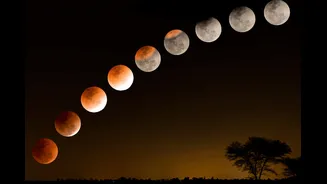
It will be a deep partial lunar eclipse, meaning most of the Moon will pass through Earth’s dark central shadow, known as the umbra. As a result, the Moon may appear reddish or copper-orange during the peak of the eclipse.
Will The Lunar Eclipse Be Visible In India?
No. The second lunar eclipse of 2026 will not be visible from India. At the time of the eclipse, the Moon will be below the horizon, making the celestial event impossible to observe from the country.
Which Countries Will Be Able To See It?
The eclipse will be visible across large parts of North America, South America, Europe, and
Africa.
Observers in these regions will be able to watch the Moon gradually move into Earth’s shadow, creating a dramatic visual display.
Will Sutak Be Observed In India?
According to Hindu religious beliefs, the Sutak period is generally observed only in places where an eclipse is visible.
Since the second lunar eclipse of 2026 will not be visible in India, most Hindu calendars (Panchang) do not consider Sutak applicable for this event.
Why Is This Lunar Eclipse Special?
This eclipse stands out because around 96% of the Moon’s surface will be covered by Earth’s umbral shadow, making it one of the deepest partial lunar eclipses in recent years.
During the maximum phase, the uncovered portion of the Moon may reflect a striking red or copper-coloured glow, a phenomenon caused by sunlight passing through Earth’s atmosphere before reaching the lunar surface.
How Does A Lunar Eclipse Occur?
A lunar eclipse happens when Earth moves directly between the Sun and the Moon, causing Earth’s shadow to fall on the Moon.
A total lunar eclipse occurs when the entire Moon passes through Earth’s shadow.
A partial lunar eclipse occurs when only a portion of the Moon enters the shadow.
The August 2026 event falls into the second category, but its unusually high coverage makes it one of the most impressive partial eclipses in years.
(Disclaimer: The information in this article is based on available astronomical data and commonly followed religious beliefs. Readers are advised to refer to official astronomical organisations and local Panchangs for the latest updates.)