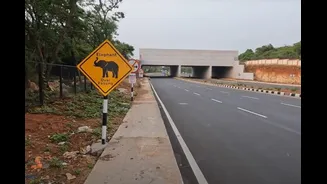









In the quiet, pre-dawn hours of Sunday, March 8, 2026, a lone tusker made history on the outskirts of Bengaluru. As it stepped cautiously across a lush, soil-covered bridge spanning NH-209 (Kanakapura
Road), a hidden camera trap clicked, capturing the first definitive proof that Karnataka’s inaugural elephant overpass is a success.
This 3:58 AM encounter has vindicated years of conservation efforts, proving that even the most fragmented wildlife corridors can be restored with the right engineering and ecological foresight.
From Tragedy to Blueprint: How the Location was Chosen
The decision to build this overpass was born out of a grim necessity. For decades, the stretch near Tataguni, situated behind the Roerich and Devika Rani Roerich Estate, was a point of lethal conflict. This specific location serves as a narrow but vital “neck” connecting the Bannerghatta National Park (BNP) to the Savandurga forests in Ramanagara.
While some sceptics initially argued that this wasn’t a “traditional” corridor, the data told a different story. The breaking point occurred in March 2023, when a wild elephant was killed after being struck by a BMTC bus while attempting to cross the highway.
The tragedy sparked public outrage and forced a shift in policy. The Bengaluru Urban forest division and wildlife experts identified this exact spot as a high-frequency crossing point where the forest’s edge met the asphalt, making it the non-negotiable site for the overpass.
A Three-Year Engineering Feat
Construction on the project began in earnest in late 2023, shortly after the fatal accident. Handled by the National Highways Authority of India (NHAI) at a cost of approximately Rs 20 crore, the project faced unique challenges. Unlike standard pedestrian bridges, an elephant overpass must support immense weight and, more importantly, “feel” like the forest floor to be used by wary animals.
The resulting structure is a massive platform measuring 40 meters in width and 45 meters in length. To ensure the animals felt comfortable, DCF N Ravindra Kumar and his team insisted on creating gentle, natural slopes on both the ascending and descending sides, allowing the massive pachyderms to transition from the forest to the bridge without the stress of steep inclines.
Creating a Living Bridge
An overpass is only as good as its environment. To entice the elephants, the Forest Department collaborated with NGOs and local Resident Welfare Associations (RWAs) to transform the concrete slab into a living habitat. Hundreds of fruit-bearing trees and bamboo clusters were planted across the structure.
The strategy worked. Before the tusker was caught on camera this Sunday, foresters had noticed that elephants were hovering near the Anepalya and BM Kaval areas but were no longer leaving dung or tracks on the highway. By installing camera traps on Saturday, they finally confirmed what they suspected: the giants were now walking over the traffic rather than through it.
A Model for Future Conservation
The success of the Tataguni overpass has profound implications for India’s infrastructure planning. It proves that the “Jumbo Corridor” between Bannerghatta and Savandurga is active and that wildlife will adapt to man-made solutions if they are ecologically sound.
Beyond elephants, the cameras have revealed that leopards and other smaller mammals are also using the bridge, effectively reconnecting a severed ecosystem.
As Bengaluru continues to expand, this overpass stands as a landmark of coexistence, a Rs 20 crore investment that has finally paid its greatest dividend: the safety of a species to be protected.