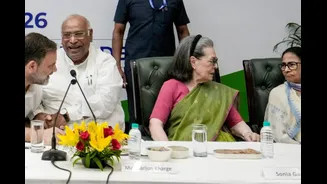









The INDIA bloc’s most crucial meeting since the assembly election setbacks opened with a forceful defence of Mamata Banerjee as opposition leaders rallied behind the Trinamool Congress chief and turned
the discussion into a broader attack on the electoral process.
Leaders familiar with the discussions told CNN-News18 that Banerjee told alliance partners that nearly 60 per cent of the West Bengal election – in which Bharatiya Janata Party (BJP) scripted history by sweeping the state – had been “rigged”.
This prompted Rahul Gandhi to immediately go further. “Not 60 per cent. One hundred per cent,” the Congress leader responded, drawing agreement from several leaders present in the room.
ALSO READ | They Showed No ‘Mamata’ Towards TMC: Who All Left After Bengal Poll Loss? Parties That Split In Past Explained
The exchange set the tone for a meeting that saw opposition parties close ranks around Banerjee despite the Trinamool Congress facing one of its most difficult political moments after its assembly election defeat and the rebellion that followed inside the party.
In a gesture that seemed to put to an end to talks of bitterness between the TMC and Congress, Sonia Gandhi described Banerjee as a “sherni” [lioness], a move seen by participants as a message that the opposition alliance was standing firmly behind the TMC chief.
Sources said Banerjee received full backing from alliance partners, with leaders arguing that the issues she raised about electoral processes needed to become a collective opposition campaign rather than a state-specific grievance.
Omar Abdullah’s Message
One of the strongest interventions at the meeting came from Omar Abdullah.
Sources told CNN-News18 that the Jammu and Kashmir chief minister argued that opposition parties needed to pay closer attention to the issues being raised by the Cockroach Janta Party (CJP) and convert them into sustained political campaigns.
“We need to learn from the issues they are raising. Don’t let CJP walk away with it,” Abdullah is learnt to have told fellow leaders.
Allies Corner Congress
While the meeting showcased solidarity on electoral issues, it also became a forum for allies to air long-standing grievances against Congress.
Left parties complained that Congress leaders attacked them during the Kerala election campaign in language that often sounded no different from BJP criticism.
ALSO READ | Mamata Bets On INDIA Bloc To Regain Ground As TMC Turmoil Deepens Internal Dissent
According to sources, Rahul Gandhi acknowledged the concern but defended some of the rhetoric by saying Congress also had to consider the views and political compulsions of its state units. “I have to listen to my state unit also,” Rahul is learnt to have told leaders.
The exchange mirrored concerns publicly reported by several INDIA bloc partners before the meeting. Leaders from regional parties urged Congress to show greater restraint in dealing with allies and avoid unnecessary confrontations in states where opposition parties are competing against each other. Multiple allies urged Congress to be more “large-hearted” if the INDIA bloc is to remain effective through 2029.
From Complaints To Consensus
The meeting came amid visible strains within the alliance. The DMK skipped the gathering, Kerala tensions between Congress and the Left remain unresolved, and several regional parties have privately complained about Congress’s tendency to dominate opposition strategy.
Yet by the end of the discussions, leaders appeared determined to project unity.
According to media reports, Rahul Gandhi responded to ally concerns with a conciliatory message, stressing the need for “love” and cooperation within the alliance. Congress leaders also assured partners that better coordination mechanisms would be created going forward, reflecting a growing concern within the opposition that while public discontent exists on several issues, the alliance has often struggled to build a unified national narrative around them.
The Common Thread: Elections
What united the room was the belief that electoral issues could become the alliance’s biggest political plank.
The discussion around Banerjee’s claims, Rahul Gandhi’s response, and Omar Abdullah’s intervention all fed into a broader consensus that the opposition must campaign more aggressively on voter rolls, election management and electoral transparency.
That was reflected in the INDIA bloc’s formal decisions after the meeting, including a coordinated campaign on electoral issues, greater parliamentary coordination and more frequent meetings among alliance partners.
Clearly, the significance of the meeting was not the five-point action plan announced afterwards. It was the message sent inside the room.
At a time when Mamata Banerjee is facing political turbulence at home and when several alliance partners remain unhappy with Congress, the opposition’s top leaders chose to publicly close ranks and decide that the next political battle will be fought less on leadership questions and more on the credibility of the electoral process itself.