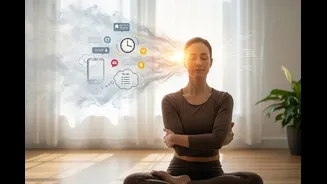









Do you find yourself reading the same paragraph over and over again, or forgetting why you opened the refrigerator? Perhaps you lie awake at night with thoughts moving in every direction?
Before you start
blaming the digital era of ‘constant notifications and endless scrolling’, remember that absent-mindedness and restlessness have existed long before this era dawned.
The metaphor of the ‘monkey mind’—and even a ‘donkey mind’—has been around for centuries in Chinese and Japanese Buddhist and Zen traditions. Yoga described the same restless mental state centuries earlier in the Upanishads and the Gita.
Mind States in The Yoga Sutras
Later, Patanjali’s Yoga Sutras classified the unfocussed mind into three states, or chitta bhumis:
Kshipta – scattered and agitated
Vikshipta – distracted; attention comes and goes
Mudha – dull, forgetful and demotivated
These three states—as opposed to ekagra (one-pointed and steady) and niruddha (fully restrained)—were not considered suitable for Yoga.
Most people today oscillate between mudha, kshipta, and vikshipta—often within the same day. The mind moves from one state to another depending on how we live, eat, breathe and rest.
Since these states are influenced by lifestyle, they are also changeable. Poor concentration, forgetfulness, and mental fatigue can be reversed through changes in daily living.
Yoga comes in handy here: its practices can help convert lethargy to activity, and agitation and hyperactivity to calm—and finally to steadiness.
Yoga Approaches It Practically
Instead of forcing the mind to concentrate, Yoga works with the breath and awareness practices to make the shift.
Out of the many practices, three that I’ve found especially effective are: Kapalabhati, Full Yogic Breathing, and Nispanda Bhava.
Kapalabhati – From Tamas to Rajas
The name itself alludes to bringing light to the head region. The forceful exhalations and passive inhalations of this practice stimulate the mind.
In yogic terms, it moves the mind out of the inertial state of tamas to an active state of rajas. This helps overcome lack of energy and lack of motivation, and mental exhaustion.
You feel invigorated even after just five rounds, exhaling around 40 strokes per minute. The spontaneous kumbhaka or cessation of breath after each round feels deeply relaxing.
Full Yogic Breathing – From Rajas to Sattva
This practice is about controlled breathing and using the full capacity of the lungs.
The deep inhalation and prolonged exhalation progress through three phases—the abdomen, chest cavity, and upper chest and collarbone area. This makes it a combination of diaphragmatic, thoracic, and clavicular breathing.
The prolonged focus within the body, as you let various regions expand, is in itself a form of meditation. With the body thus full of prana, it gives a sense of the body as a microcosm.
In general, Pranayama is the best aid for concentration and meditation, as it cleanses impurities of the mind.
According to the renowned yogi Swami Sivananda: “The energy in the body is prana. By controlling the motion of lungs, we can control the prana vibrating inside. By controlling prana, the mind can be easily controlled, because the mind is fastened to the prana, like the bird to the string.”
To practise full Yogic breathing:
• Sit comfortably on a chair. Relax the abdomen and shoulders. Keep the back upright, without forcing it.
• Inhale slowly through the nose, letting the abdomen expand like a balloon.
• Continue the inhalation into the chest region, widening it and allowing the ribs to move outward.
• Inhale further, allowing the collarbones to lift up.
• To release the breath, exhale slowly by relaxing the shoulder and clavicles, then letting the ribs withdraw inward, and finally drawing the belly towards the spine.
Yogendra Nispanda Bhava – From Vikshipta to Ekagra
‘Niṣpanda’ means absence of movement. The practitioner sits still, adopting a ‘bystander’ attitude, with just one sense—hearing—active. This withdrawal, or pratyahara, teaches the mind to remain with one experience, transcending distraction.
This practice can lead the practitioner to spontaneous meditation. It helps one to take the mind out of the body, which enables healing.
To practise Yogendra Nispanda Bhava:
• Sit on a mat, against a wall for support, with legs stretched out and comfortably apart. Ensure the spine remains naturally straight. Rest the hands loosely on the thighs.
• Select any sound in the surroundings – the ticking of a clock or the sound of the fan. Close your eyes.
• Listen to the sound passively. Simply remain aware of it as it falls on your ears. Don’t strain to concentrate or focus hard.
These practices slowly help develop concentration. The good news: a distracted mind today does not mean a distracted mind forever; neither is Yoga reserved only for yogis or mystics.
Yoga’s practical techniques can help all of us ordinary people to hold on and remain steady amidst modern pressures. From tamasic lethargy and rajasic agitation, these can lead the mind—when practised daily—towards sattvic clarity. And further towards steady focus.
The author is a journalist, cancer survivor and certified yoga teacher. She can be reached at swatikamal@gmail.com.