
The European Union and United Kingdom have said they “will not be blackmailed” by US President Donald Trump and his “completely wrong” imposition of 10 percent tariff on several member countries for “opposing”
his threats to control Greenland.
Greenland, meanwhile, praised European countries for their strong response to the tariffs linked to the future of the Arctic island. Several European leaders condemned the move as “unacceptable” even as
Denmark said they “come as a surprise”.British Prime Minister Keir Starmer called the imposition of the tariff “completely wrong” while French President Emmanuel Macron and Swedish PM Ulf Kristersson wholly rejected it and spoke of defending European sovereignty.
On Saturday (January 18), Trump said he will impose 10 percent tariff February onwards on eight European countries for opposing US control of Greenland. In a social media post, he said Denmark, Norway, Sweden, France, Germany, the UK, the Netherlands, and Finland will face the tariff and that it would climb to 25 percent on June 1 if a deal is not in place for “the Complete and Total purchase of Greenland”.
Calling an emergency meeting of ambassadors from the EU’s 27 countries on Sunday, bloc leaders warned of a “dangerous downward spiral” in wake of Trump’s threats.
“Tariffs would undermine transatlantic relations and risk a dangerous downward spiral. Europe will remain united, coordinated, and committed to upholding its sovereignty,” European Commission President Ursula von der Leyen and EU Council President Antonio Costa said in posts on X.
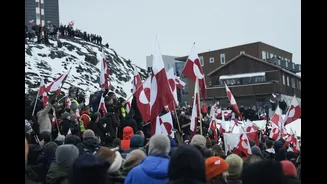
The reactions came in as thousands of Greenlanders braved near-freezing temperatures and marched across snow and ice to take a stand against Trump. They held signs of protest, waved their national flag and chanted “Greenland is not for sale” in support of their own self-governance.
‘COME AS A SURPRISE’
Greenlandic minister Naaja Nathanielsen praised the reaction of European countries targeted by Donald Trump’s new tariff threats.
“I am amazed to witness the first responses from the targeted countries,” Nathanielsen, who is the minister for mineral resources, said in a message posted on LinkedIn. “I am thankful and hopeful for diplomacy and allieship to prevail.”
Denmark’s foreign minister, meanwhile, called Trump’s threat to impose tariffs on European countries that do not let him acquire Greenland a “surprise”.
“The purpose of the increased military presence in Greenland, to which the president refers, is precisely to enhance security in the Arctic,” Denmark’s foreign minister Lars Lokke Rasmussen told AFP. “We are in close contact with the European Commission and our other partners on the matter.”
Only a few days ago, he had attended talks in the White House with the US and Greenlandic officials on the Greenland question.
‘COMPLETELY WRONG’
British Prime Minister Keir Starmer condemned Trump’s threat as “completely wrong”.
“Applying tariffs on allies for pursuing the collective security of Nato allies is completely wrong. We will of course be pursuing this directly with the US administration,” Starmer said in a statement.
“We have also made clear that Arctic Security matters for the whole of Nato and allies should all do more together to address the threat from Russia across different parts of the Arctic,” he added.
‘UNACCEPTABLE’
French President Emmanuel Macron denounced Trump’s threat and said they are “unacceptable” while Swedish PM Ulf Kristersson said “we won’t let ourselves be intimidated”.
“Tariff threats are unacceptable and have no place in this context,” Macron posted on X, in French and English. “Europeans will respond in a united and coordinated manner should they be confirmed. We will ensure that European sovereignty is upheld. It is in this spirit that I will engage with our European partners.”
Kristersson told AFP in a message: “We won’t let ourselves be intimidated. Only Denmark and Greenland decide questions that concern them. I will always defend my country and our allied neighbours.”
“Sweden is currently having intensive discussions with other EU countries, Norway and the United Kingdom to find a joint response,” he added.
(With agency inputs)