





What happens to a pen when it runs out of ink or is no longer needed? At a Durga Puja pandal in Kolkata, the answer is rather unexpected. Thousands of pens and refills have been brought together to create
a 5.5-foot sculpture of Goddess Durga, turning an everyday writing instrument into an unusual work of festive art.
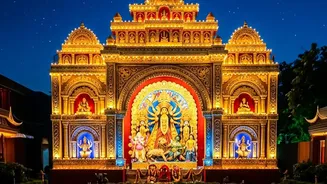
Created by Kolkata-based artist Chandra Nath Saha, popularly known as Tilak, the installation at Tridhara Sammilani in south Kolkata uses approximately 13,000 Pentonic pens and an equal number of refills made from recycled plastic. Displayed alongside the pandal’s main Durga idol, the sculpture brings together artistic ingenuity and a fresh perspective on material reuse, giving a familiar object an entirely different purpose.
The installation is particularly interesting because its story does not end with its display during the festival. Unlike the main Durga idol, which follows the traditional immersion ritual during Visarjan, the pen sculpture is intended to be dismantled after the celebrations, with its plastic components set to be recycled into new products, including pens.
How 13,000 Pens Came Together To Create Goddess Durga
Measuring approximately 5.5 feet in height, 4.5 feet in width and 3 feet in depth, the sculpture brings together thousands of individual writing instruments to create a recognisable representation of Goddess Durga.
For Saha, the challenge lay in working with a material that was never designed for sculpting. Each pen had to become part of a larger composition, with the overall structure retaining the proportions and visual character of the goddess. The face, in particular, required careful attention to ensure that its finer details and expression remained recognisable.
Reportedly, the project took more than 20 days to complete, involving several stages of planning, preparation and execution. The artist also received support from the Tridhara Sammilani team, which encouraged the unconventional creative approach.
Speaking to The Statesman, Saha explained that what drew him to the project was the possibility of transforming something as familiar and functional as a pen into an artistic expression of Maa Durga. The process, he said, involved understanding how thousands of individual objects could come together to create a form with considerable cultural and emotional significance.
The installation was presented by Pentonic, the writing instrument brand owned by Linc Limited. Rather than replacing the traditional Durga idol, it was conceived as a separate artwork that sits alongside it, offering visitors another way to engage with the festival’s artistic traditions.
Most of us rarely give much thought to what happens to a plastic pen once it is no longer useful. Small, commonplace and easy to overlook, writing instruments are part of everyday life, from classrooms and offices to homes and workplaces.
At Tridhara Sammilani, these familiar objects have been brought together on a scale that makes them difficult to ignore. Thousands of pens that would ordinarily be associated with writing have been assembled into a sculpture, encouraging visitors to look beyond their original function.
The choice of material also introduces a conversation around recycling. The pens and refills used for the installation are made from recycled plastic, demonstrating how such materials can be incorporated into a creative project rather than being limited to their original application.
There is, however, an important distinction between using recycled plastic and reusing discarded pens. The reported installation uses writing instruments made from recycled plastic; this does not establish that all 26,000 components were individually collected as waste.
What makes the project noteworthy is the way it brings material reuse into a public cultural setting. Visitors encounter the idea not through a conventional awareness campaign, but through an artwork that invites curiosity first and reflection afterwards.
What Happens To The Pen Sculpture After Durga Puja?
One of the most distinctive aspects of the installation is its intended next chapter.
While the main Durga idol will undergo the customary immersion ritual during Visarjan, the pen sculpture will remain outside that process. After the festival, the installation is to be dismantled separately, with its plastic components sent for recycling and use in manufacturing new products, including pens.
This planned approach gives the artwork a life beyond its time at the pandal. Instead of remaining a one-time installation, the materials are intended to return to the production cycle, where they can be used to make something new.
Durga Puja pandals are often celebrated for their ability to transform ordinary spaces and materials into elaborate artistic experiences. This installation adds another dimension to that tradition by considering what happens to the materials once the festivities are over.
In Kolkata, Durga Puja is not only a religious celebration but also an occasion for artists to experiment with form, material and interpretation. Each year, pandals become spaces where familiar cultural imagery meets new creative ideas, offering visitors different ways to experience the festival.
At Tridhara Sammilani, the pen sculpture follows that spirit of experimentation. Its subject is deeply rooted in Bengal’s cultural imagination, while its material belongs to the everyday world of manufactured products and modern consumption.
And perhaps that is what makes the project particularly compelling, an object as ordinary as a pen can become something unexpected when viewed through an artist’s imagination.