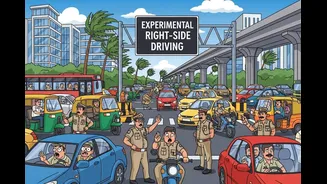







India drives on the left side of the road, a rule that has shaped road design and driving habits for decades. But Bengaluru—one of the country’s most congested cities—may soon experiment with a dramatic
shift in traffic management at select intersections.
According to a report by The Times of India, the Bengaluru Traffic Police is considering introducing American-style right-side driving near some of the city’s most congested junctions as part of a pilot initiative aimed at easing bottlenecks.
What The Proposal Says
India follows a left-hand traffic (LHT) system, where vehicles drive on the left side of the road and overtake from the right.
Under the proposed system, however, vehicles approaching certain junctions may temporarily shift to the right side of the road to pass through the intersection more efficiently before merging back into regular traffic flow.
Traffic authorities believe the change could help manage heavy traffic at intersections where conventional signal cycles and lane arrangements fail to prevent long queues.
The plan is not to convert entire roads to right-side traffic, but to modify traffic movement patterns near specific junctions—particularly those where right-turning vehicles block straight-moving traffic.
Why Bengaluru Is Experimenting With New Traffic Models
The move reflects the city’s ongoing struggle with congestion. Bengaluru frequently ranks among India’s most gridlocked urban centres, with peak-hour traffic delays stretching commuting times significantly.
Urban planners say intersections are often the weakest point in traffic systems, where signal delays, poorly designed turning lanes and mixed traffic cause vehicles to pile up.
Traffic engineering solutions worldwide often focus on redesigning junction movement patterns — such as restricting turns, introducing dedicated slip roads or reorganising lane directions — to keep vehicles moving.
How ‘Right-Side’ Systems Work Elsewhere
Countries like the United States follow a right-hand traffic (RHT) system, where vehicles drive on the right side of the road and overtake from the left.
In some cities globally, traffic authorities also allow manoeuvres such as turning right at red lights after stopping, a rule intended to reduce unnecessary waiting at intersections.
While Bengaluru’s proposal is not identical to those rules, the idea of temporarily changing vehicle movement at intersections is inspired by similar traffic-management experiments used in other countries.
Experts Urge Careful Implementation
Transport experts say such a shift could improve flow at problem junctions—but only if accompanied by clear road markings, proper signage and public awareness campaigns.
Drivers in India are deeply conditioned to left-side driving, and any temporary reversal of movement could lead to confusion if not communicated clearly.
Traffic engineers also point out that intersection redesign must account for pedestrian crossings, bus movements and two-wheelers, which form a large share of Bengaluru’s traffic mix.
A Pilot Before Wider Rollout
As reported by The Times of India, authorities are still studying the feasibility of the system and gathering expert opinions before implementing it at selected junctions.
If the pilot succeeds, the city could expand the model to other traffic-heavy locations as part of broader efforts to tackle Bengaluru’s chronic congestion.