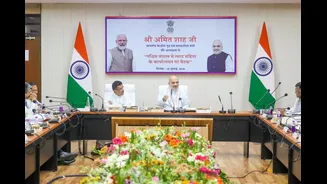











Union Home Minister and Minister of Cooperation Amit Shah on Sunday chaired a high-level review meeting on the law and order situation in West Bengal, outlining a comprehensive roadmap to strengthen the state’s
internal security, policing and criminal justice system.
The meeting focused on counter-terrorism, border security, narcotics control, police modernisation, cyber security and women’s safety. Shah also directed officials to implement a series of measures within a stipulated timeframe.
Key Decisions
The Union Home Minister directed the state administration to:
- Establish an Anti-Narcotics Task Force (ANTF), an Anti-Terrorist Squad (ATS) and a Special Investigation Agency (SIA) on the lines of the National Investigation Agency (NIA).
- Launch a Women’s Outreach Programme, prioritising the safety of women in rural areas through regular engagement, awareness campaigns and empowerment initiatives.
- Ensure that the NIA conducts a comprehensive review of all terrorism- and UAPA-related cases concerning West Bengal.
- Remove illegal encroachments from government land in border areas.
- Modernise the West Bengal Police with adequate financial support from the Centre, improve infrastructure, strengthen service delivery and enhance police capabilities.
- Convert one-third of the security camps in areas formerly affected by Left-Wing Extremism into Public Service Centres to improve access to government services.
- Strengthen cyber security capabilities, hold regular NCORD meetings to combat narcotics trafficking and prepare a comprehensive flood management plan for Kolkata.
Why The Security Overhaul?
West Bengal shares international borders with Bangladesh, Nepal and Bhutan, making it one of India’s most strategically sensitive states from a national security perspective. Its geographical location has long posed challenges related to cross-border terrorism, illegal infiltration, narcotics trafficking, organised crime and other security threats.
According to sources, two broad messages emerged from the Union Home Minister’s review. The first is the Centre’s intention to eliminate the perception of West Bengal as a transit route for terrorist networks. The second is to build a stronger security architecture through specialised agencies with dedicated investigative and operational capabilities.
Why Is The Centre Proposing An SIA?
The proposed Special Investigation Agency (SIA) is expected to function as a state-level investigative agency on the lines of the National Investigation Agency (NIA).
Sources said the move is driven by the need for detailed investigations into bomb blasts and explosives-related cases, which have frequently posed law-and-order challenges in the state. While the NIA investigates selected terror-related offences, it is not feasible for the central agency to probe every bomb explosion or suspected terror-linked case.
The proposed SIA would, therefore, undertake detailed investigations into such cases at the state level while coordinating with central agencies whenever required.
Officials also pointed out that similar agencies already function in Jammu and Kashmir, Gujarat and several other states.
The proposed SIA is expected to focus on:
- Terror-related offences
- Terror financing
- Narcotics-linked organised crime
- Bomb blast and explosives-related investigations
Why An Anti-Terrorist Squad?
The proposed Anti-Terrorist Squad (ATS) will serve as a specialised operational unit dedicated to counter-terrorism.
According to sources, its primary focus will be on:
- Identifying and dismantling sleeper cells
- Conducting intelligence-based counter-terror operations
- Monitoring cross-border terror networks
- Preventing terrorist activities and radicalisation
- The ATS is expected to have dedicated infrastructure, including its own headquarters, as well as additional specialised officers and enhanced operational resources.
Strengthening The Anti-Narcotics Task Force
The Centre is also planning to significantly strengthen the Anti-Narcotics Task Force (ANTF) by increasing its manpower and expanding its operational capacity.
The objective is to intensify efforts against narcotics trafficking, particularly along international border routes, and improve coordination among the state police, central agencies and intelligence organisations.
A Broader Security Strategy
The proposed creation of the SIA, expansion of the ATS and strengthening of the ANTF form part of a broader strategy to reinforce West Bengal’s security framework. Alongside police modernisation, enhanced cyber security, stronger border enforcement and improved coordination among investigative agencies, the Centre aims to build a more robust mechanism to address terrorism, terror financing, narcotics trafficking and organised crime in the state.