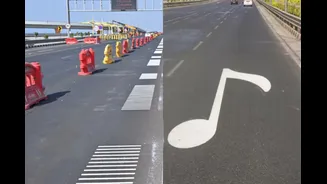










It was billed as a feat of engineering — India’s first musical road, playing AR Rahman’s Oscar-winning ‘Jai Ho’ as you drove over it at exactly the right speed. Six weeks later, the same stretch is barricaded
every night because the neighbours cannot sleep. Mumbai’s most tuneful infrastructure experiment has hit a jarring note.
What Is The ‘Jai Ho’ Road?
Mumbai’s musical road was inaugurated on the Coastal Road between Nariman Point and Worli, where precisely cut grooves — known as rumble strips — cause vehicle tyres to produce the rhythm of “Jai Ho” when driven over at 70 to 80 kmph.
The tune remains audible even with car windows rolled up. The project was conceptualised by former MP Rahul Shewale, executed with technical expertise from Hungarian specialists, and commissioned by the BMC at an estimated cost of Rs 6.21 crore.
The concept of melody roads first emerged in Japan in 2007, when engineer Shizuo Shinoda discovered that grooves in road surfaces could produce musical tones if driven over at specific speeds.
Countries like Hungary, South Korea, and the UAE have since built similar stretches. Mumbai’s installation is only the fifth known melody road in the world.
Chief Minister Devendra Fadnavis personally experienced the musical drive at the inauguration.
So What Went Wrong?
The novelty wore off faster than expected — at least for those living nearby. The road generated noise levels of 60 to 65 decibels inside residential homes, drawing over 650 complaints from residents.
The Advanced Locality Management of Breach Candy wrote to the Maharashtra government and BMC Commissioner urging immediate intervention. After reviewing the situation, the civic body decided to barricade the musical road at night — the stretch now remains completely closed to traffic between 10 pm and 7 am.
A noise study was conducted first, with evening barricades piloted on weekends before being extended. Residents say their nights are quieter. The project, however, now requires daily staff to manage the barricades — an operational cost nobody had apparently planned for.
What Is The Internet Saying?
Reactions online have ranged from dry to scathing. “First create a problem that does not exist, then create a solution to that problem,” wrote X user @RoadsOfMumbai. “Petty planning, petty infrastructure.”
Others questioned the origins of the idea. “The musical road was actually a proposal from the Hungarian Consulate to the BMC,” noted @ugach_kahitarii. “They had mentioned it would enhance the driving experience. 6.21 crore down the drains.”
The class angle did not go unnoticed either. “…Because it was affecting the elite,” wrote @Prithvi10_, pointedly. @payal_jos kept it simple: “Whose musical idea was this in the first place?”
User @priya_27_ drew the contrast that stung the most: “Babus really love wasting money on unnecessary stuff, and when it comes time to fix a road, they put in bumpy patches that make every car ride a gamble with your life.”
@iNikhilsaini went further: “Approximately Rs 6 crore was spent on this musical road. The person who came up with this idea should pay this money.”
One user even reached for economics. @asthan82911 invoked the Austrian economist Ludwig von Mises, arguing the fiasco was a textbook case of governments making decisions without any system of profit and loss to keep them honest.
The Bigger Question
Mumbai’s roads are notoriously among the worst in any major Indian city — potholed, flooded during monsoon, and perpetually under repair. Against that backdrop, a Rs 6.21 crore road that plays AR Rahman at the right speed — and now needs to be silenced at night — has become an easy symbol of misplaced priorities.
The residents got their quiet evenings. Everyone else got a reminder of what Rs 6 crore could have fixed instead.