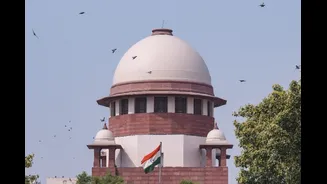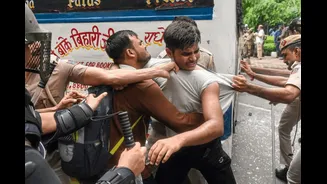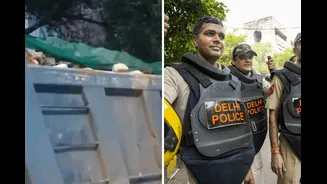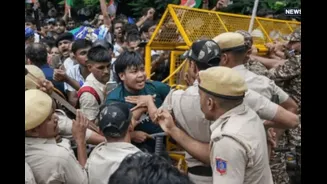





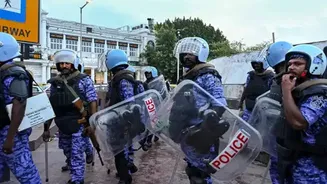
The Supreme Court on Thursday examined a plea challenging the use of metallic pellet guns by police during the CJP protests at Delhi’s Jantar Mantar, observing that police rules permit such measures only
“in exceptional circumstances” while asking the Centre to explain the standard operating procedure (SOP) governing their use.
A bench headed by Chief Justice of India Surya Kant and comprising Justice Joymalya Bagchi issued notice to the Centre on the petition and sought its response on the rules and SOP relating to the deployment of pellet guns by police.
During the hearing, senior advocate Vrinda Grover, appearing for the petitioners, argued that the pellet guns used against protesters fired “kinetic metallic projectiles”, distinguishing them from rubber or plastic pellets.
Explaining the distinction, Grover told the court, “There can be rubber, plastic and metallic pellets. These were metallic and recovered from the bodies. Nature of the crowd will determine use of this as well. Was it a violent mob? No. These metallic pellets were fired.”
Responding to the submissions, Justice Bagchi said, “But police rules allow the use in exceptional circumstances unless you challenge the rules themselves. One of the steps of graded approach is use of pellet guns.”
Grover, however, maintained that the challenge was limited to the use of metallic pellets and not pellet guns in general. “I wish the Delhi Police or the government doesn’t wish to fire metallic pellets on young people,” she said, urging the Union government to place the relevant rules and guidelines on record.
‘Not Averse To Examining Legality Of Pellet Gun Use’
The court indicated it was open to examining the legality of pellet gun use in a specific incident but noted that the petitioners would have to demonstrate whether such use was impermissible under the graded response framework.
“We are not averse to examining the use of pellets in an individual case. You have to show us if graded response use of pellets can be allowed when even bullets are used in some situations,” Justice Bagchi observed.
Chief Justice Surya Kant suggested that the petition could instead seek judicial guidelines governing the use of pellet guns. “In light of alleged excessive use.. your prayer should be that the court lays down a protocol regarding the use,” the CJI said.
Grover agreed, clarifying, “Yes, only metallic pellets.”
During the hearing, Justice Bagchi recalled a past police regulation struck down by the Calcutta High Court, saying, “In Calcutta HC there was a rule that bullets should be fired at the chest to preserve ammunition and not any other body area.”
Solicitor General Tushar Mehta responded, “must be some colonial era..”, to which Justice Bagchi added that the rule had been set aside and that the petitioners would have to establish whether existing regulations governing pellet guns were arbitrary.
Grover argued that there was no known standing order of the Delhi Police authorising the use of pellet guns. “There is no standing order of Delhi police mandating the use of pellets…if that is there.. let it be placed..I am sure Union or NCT does not want to fire pellets at students..” she submitted.
‘Graded Force May Be Necessary’
Justice Bagchi stressed that the court supported a non-violent approach towards student protests but acknowledged that graded force may be necessary in certain situations.
“We are in agreement with your prayer for no violence principle on persons expressing dissatisfaction or protesting. But graded response may be required in some cases. The best way is to arm police personnel; that gives them confidence…everyone is a human being. If someone is coming with a lathi, you will take a few more moments before reaction,” he said.
The Supreme Court has now issued notice to the Centre and sought its response, specifically asking the government to place on record the SOP governing the use of pellet guns by police.
All About Pellet Gun Row
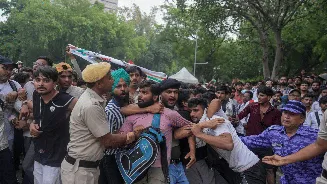
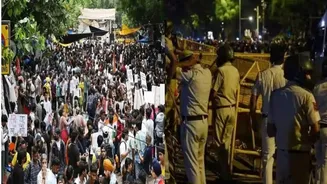
The Cockroach Janta Party had organised the ‘Chalo Sansad’ march on July 20 amid protests over the NEET-UG paper leak controversy, which had left lakhs of students affected nationwide.
The march was marred by violence, with clashes breaking out between demonstrators and security personnel at multiple locations around Jantar Mantar and nearby areas.
According to Delhi Police, more than 65 protesters and over 200 police personnel were injured in the unrest. The alleged use of plastic pellets by security forces during the operation later became a major political flashpoint after reports claimed that several protesters had sustained grievous injuries.
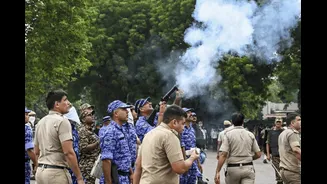
According to official records, the Rapid Action Force (RAF) fired 55 non-electrical shells, 15 electrical shells, five tear smoke grenades, two rounds from anti-riot guns and two rounds of plastic pellets while dispersing the crowd.
Police officials said each round of plastic pellets contains four plastic projectiles designed to cause less serious injuries than metal pellets.
Meanwhile, the use of pellet guns and other non-lethal crowd-control measures during the ‘Chalo Sansad’ protest was authorised by Delhi Police and carried out in accordance with standard operating procedures (SOPs), according to a post-event review by the Central Reserve Police Force (CRPF) accessed by The Times of India.
The CJP ended its 36-day sit-in at Jantar Mantar on Saturday, announcing that the Centre had accepted several of its key demands.
These included the resignation of then Union Education Minister Dharmendra Pradhan, withdrawal of FIRs against protesters, protection from retaliatory action and a commitment to examine wider reforms in the examination system.