


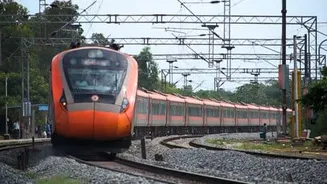

Bullet Train Update: With Diwali and Chhath approaching, a proposed high-speed rail corridor connecting Delhi with major cities across Uttar Pradesh and Bihar has received a major update from Railway Minister
Ashwini Vaishnaw.
The proposed corridor could bring down the journey between Delhi and Patna to around four and a half hours, compared with roughly 12 hours at present. The plan is expected to connect the national capital with Agra, Kanpur, Lucknow, Prayagraj, Varanasi and Patna.
The update comes at a time when festive travel between Delhi, Uttar Pradesh and Bihar becomes a major concern for passengers. Diwali falls on November 8 this year, while Chhath Puja will be observed on November 15.
Delhi-Patna Journey Could Drop To 4.5 Hours
Ashwini Vaishnaw said the proposed high-speed rail project would connect Delhi with key cities in Uttar Pradesh and Bihar, significantly reducing travel times.
Under the plan, the approximately 1,170-kilometre Delhi-Patna journey is estimated to take around 4.5 hours. The Delhi-Lucknow trip, meanwhile, could be completed in about 2 hours 12 minutes.
For passengers travelling during major festivals such as Diwali and Chhath, the proposed reduction in journey time could eventually make long-distance travel between the national capital and eastern Uttar Pradesh and Bihar considerably quicker.
Agra To Varanasi Also On Proposed Route
The proposed corridor would serve several major cities along the Delhi-UP-Bihar belt.
According to the travel-time estimates shared by the Railway Minister:
- Delhi to Agra: Around 58 minutes for approximately 200 km
- Delhi to Kanpur: Around 1 hour 50 minutes for approximately 455 km
- Delhi to Lucknow: Around 2 hours 12 minutes for approximately 495 km
- Delhi to Prayagraj: Around 3 hours for approximately 750 km
- Delhi to Varanasi: Around 3 hours 33 minutes for approximately 945 km
- Delhi to Patna: Around 4.5 hours for approximately 1,170 km
These figures would represent a substantial reduction from current rail travel times on the respective routes.
Why The Delhi-Patna Route Matters
The Delhi-Patna rail corridor is among the country’s heavily used long-distance routes, particularly during festival periods when large numbers of people travel between the national capital and Bihar.
The proposed high-speed connection could provide an alternative for passengers travelling between Delhi, Uttar Pradesh and Bihar. It could also improve access to major religious and tourist destinations, including Agra, Prayagraj and Varanasi.
The faster connections are expected to have wider benefits for tourism, business, investment and economic activity across the region if the project materialises.
Bullet Train Network To Expand Beyond Mumbai-Ahmedabad
The proposed Delhi-UP-Bihar corridor would represent a major expansion of India’s high-speed rail ambitions beyond the Mumbai-Ahmedabad project.
The Mumbai-Ahmedabad High-Speed Rail corridor, India’s first dedicated bullet train project, spans around 508 km and is designed for a maximum operating speed of 320 kmph, with a design speed of up to 350 kmph. The corridor is expected to begin its first service in August 2027, with the Surat-Vapi section planned as the initial stretch.
The Mumbai-Ahmedabad corridor is expected to connect the two cities in around 1 hour 58 minutes with four stops. With all 12 planned stations, the journey is expected to take about 2 hours 17 minutes.
Delhi-UP-Bihar Could Be Next Major High-Speed Rail Phase
Ashwini Vaishnaw described the proposed Delhi-UP-Bihar connection as the next major phase of the country’s bullet train network after Mumbai-Ahmedabad. If realised, it would create a high-speed rail link from Delhi to several major urban centres across Uttar Pradesh and Bihar, rather than connecting just two major cities.
The proposed route is therefore significant not only for reducing journey times but also for creating a faster transport link across one of India’s most densely travelled regions.
What About The Current Rail Network?
Indian Railways already operates premium services such as Rajdhani, Vande Bharat and Duronto on various routes. However, the proposed high-speed corridor would operate at speeds well above those of conventional and semi-high-speed services.
Vande Bharat trains have a design speed of around 180 kmph, while the Mumbai-Ahmedabad high-speed rail project is designed for trains operating at up to 320 kmph.
For Delhi, Uttar Pradesh and Bihar, the proposed corridor could therefore mark a major change in how passengers travel between the region’s biggest cities – particularly during periods of intense festive demand.
Festive Travel Angle
For millions travelling home for Diwali and Chhath, however, the proposed bullet train is a promise for the future rather than an immediate travel option.
Diwali will be observed on November 8, 2026, followed by Chhath Puja on November 15.
The significance of the latest announcement lies in what it could mean for future festive journeys: a Delhi-Patna trip that currently takes around 12 hours could eventually be reduced to about 4.5 hours if the proposed high-speed rail corridor becomes a reality.