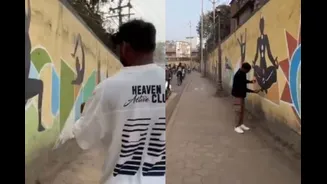









In Gwalior, Madhya Pradesh, a roadside wall displayed simple black silhouette paintings of women captured in various yoga poses. Most passersby barely glanced at the faceless, detail-free figures. But
what happened next transformed these artworks into a chilling symbol of something far more disturbing.
The paintings were deliberately vandalised, with scratches focused around areas linked to female anatomy. Though the figures had no facial features or distinct traits, someone chose to deface the artwork by targeting specific parts, exposing a troubling undercurrent behind the act.
Man Fixes Graffiti Defaced By Miscreants In Gwalior
Now, a video has surfaced online showing a man repainting the damaged sections of the graffiti. Using black paint, he carefully covered the scratched-out portions to restore the silhouettes to their original form. One by one, he worked on each yoga posture that had been defaced.
The footage was shared on X (formerly Twitter) with the caption, “Women are not safe even in graffiti in Gwalior, Madhya Pradesh. A young man tried fixing graffiti of Yoga poses on the wall, which was defaced by miscreants.”
Watch The Clip Here
Women are not safe even in Grafitti
In Gwalior, Madhya Pradesh, a young man tried fixing graffiti of Yoga poses on the wall which was defaced by miscreants. pic.twitter.com/LwnoFOWUiX
— Piyush Rai (@Benarasiyaa) January 5, 2026
Sharp Criticism Online
As the video spread, it drew hundreds of comments from users who shared their reactions to both the defacement and the act of restoration. Many comments focused on the mindset behind damaging such artwork.
One user commented, “When something as harmless as graffiti becomes a target, it shows mindset problems.”
Another said, “Sick mentality in men and women is too aggressive and common in the Hindi belt than anywhere in the country.”
“At least he took the initiative when many saw this, passed by, didn’t like what was done, but ignored it,” someone else remarked.
Comparisons were also drawn with experiences abroad, as one person shared, “I have seen sooo much graffiti in the US. It’s 100 per cent decent, if not art. Some things I wish we really do learn from Americans.”
“Paintings ko bhi ghar mai rakho aur dupatta dedo (Keep the paintings inside the house and give them a dupatta too,” an individual wrote.
“And scarier is that these are mostly done by teenagers. We have seen in some posts before,” a viewer said.
“We are saying that we are free, is this freedom? Then people are asking what was our girl wearing? An animal remains an animal no matter how well trained it is,” read another comment.
How Graffiti Found Its Place In India
Graffiti in India has slowly moved beyond being seen as vandalism to being accepted as a form of public art. Around 2007, cities like Delhi and Mumbai began seeing a rise in organised street art. Since then, walls have been used to tell stories and highlight social issues.