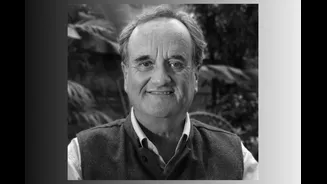

Veteran journalist and author Mark Tully, widely regarded as one of the most sensitive and authoritative chroniclers of India, passed away on Sunday at the age of 90.
Tully died at a private hospital in
Delhi after a period of illness, according to close friends and hospital sources.
Tully had been admitted to Max Hospital in Saket on January 21 and was under treatment in the nephrology department. Confirming his death, veteran journalist and longtime friend Satish Jacob said Tully passed away on Sunday afternoon.
Who Was Mark Tully?
Born on October 24, 1935, in Tollygunge in Calcutta, now Kolkata, Mark Tully spent much of his early childhood in India. Though born to well-off British parents during the colonial era, he later developed a deep personal and professional bond with the country.
After studying at a boarding school in Darjeeling, he was sent to England for further education, a move he later described as deeply unhappy.
Tully briefly considered becoming a priest and studied theology at Cambridge before abandoning the idea. His life took a decisive turn in 1964 when the BBC sent him to New Delhi as its correspondent. This marked the beginning of a long and influential career with the broadcaster, spanning nearly three decades. He became the BBC’s New Delhi bureau chief in 1972, a role he held for 22 years.
During this time, Tully reported on some of the most defining moments of modern Indian history. These included the 1971 Bangladesh war, the Emergency, Operation Blue Star, the assassinations of Indira Gandhi and Rajiv Gandhi, the anti-Sikh riots, and the demolition of the Babri Masjid.
Beyond journalism, Tully was a prolific author. His books, including ‘No Full Stops in India‘, ‘India in Slow Motion‘, ‘India’s Unending Journey‘, and ‘The Heart of India‘, offered sharp insights into Indian society, politics and culture. He also co-wrote ‘Amritsar: Mrs Gandhi’s Last Battle‘ with Satish Jacob.
Tully was knighted in 2002, received the Padma Shri in 1992, and was awarded the Padma Bhushan in 2005. Even after leaving the BBC in 1994, he continued to live in Delhi, write extensively, and present the BBC Radio 4 programme Something Understood until 2019.
Tributes Pour In
Union Minister Hardeep Singh Puri expressed his condolences on X following Tully’s passing, saying he was “deeply saddened” by the death of the celebrated journalist.
“For generations across our subcontinent, his calm and unmistakable voice was synonymous with news. As the BBC’s long-time correspondent and bureau chief in India, the Kolkata born Tully reported on some of the most defining moments in the region’s history,” Singh wrote on X.
Deeply saddened by the demise of the celebrated journalist and author Mark Tully.
For generations across our subcontinent, his calm and unmistakable voice was synonymous with news.
As the BBC’s long-time correspondent and bureau chief in India, the Kolkata born Tully reported on… pic.twitter.com/sl37uhyfC1— Hardeep Singh Puri (@HardeepSPuri) January 25, 2026
Trinamool Congress Rajya Sabha MP Sagarika Ghose also condoled his demise, calling Tully as her “personal inspiration” and praising his steadfast commitment to truth-telling.
“Stout-hearted, painstaking, full of bubbling curiosity & zest for life, Mark made India his home and reported on this country with care and love. Godspeed Mark Tully. The world badly misses your brand of truth telling fearless journalism,” Ghose wrote.
Senior journalist Vir Sanghvi said Tully was likely the greatest radio journalist of his generation, adding that he played a key role in taking India to the world.
“Mourning Mark Tully, probably the greatest radio journalist of his generation who took India to the world & who gave the BBC the credibility it once had in India. Of his many books No Full Stops in India was brilliant in predicting what India would become,” Sanghvi added.
(With inputs from PTI)