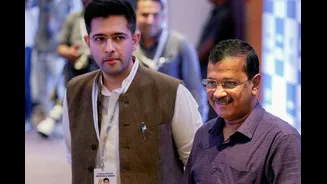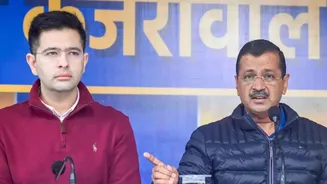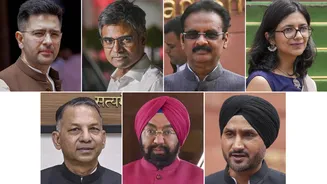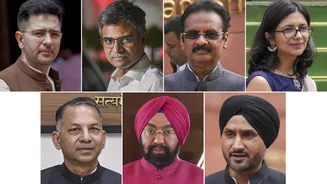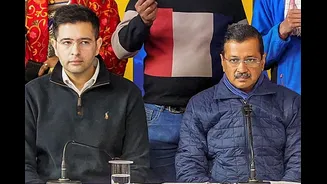






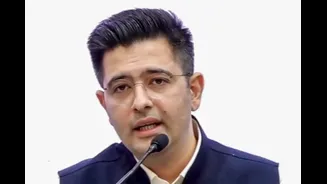
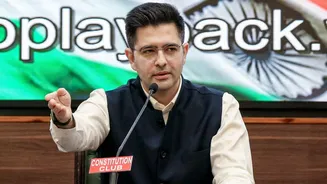

The defection of seven Aam Aadmi Party (AAP) Rajya Sabha MPs to the Bharatiya Janata Party (BJP) on April 24 has brought the “merger” exception of India’s anti-defection law under intense legal scrutiny.
The rebels, led by Raghav Chadha, claim they are protected from disqualification because they constitute more than two-thirds of the AAP’s strength in the Upper House. Are they? News18 explains.
WHAT IS THE MERGER CLAUSE?
Under Paragraph 4 of the Tenth Schedule (Anti-Defection Law), a legislator is protected from disqualification if their “original political party”merges with another party.
A merger is deemed valid only if at least two-thirds of the members of the legislature party (the elected MPs/MLAs in the House) agree to it.
With 10 MPs in the Rajya Sabha, the group of 7 meets this numerical threshold.
Since the 91st Amendment (2003) removed the “split” provision (which only required one-third support), a “merger” is now the only legal route for a large group to switch sides without losing their seats.
WHY IS THE CLAUSE UNDER SCRUTINY?
Legal experts and the AAP leadership argue that the “merger” clause is being misused as a “split” in disguise.
The central debate is whether a mergercan happen locally (just within the House) or must happen organizationally (the entire AAP party merging with the BJP).
Legislators argue that two-thirds support in the House is sufficient for a valid merger.
The AAP claims that unless the “original political party” (led by Arvind Kejriwal) merges with the BJP, the MPs cannot unilaterally declare a merger.
POLITICAL PARTY VS LEGISLATIVE WING: WHAT THE SC SAID IN SHIV SENA CASE
The Supreme Court’s judgment in Subhash Desai vs. Principal Secretary, Governor of Maharashtra (2023) addressed the constitutional crisis following the split of the Shiv Sena party. On May 11, 2023, a five-judge Constitution Bench led by Chief Justice D.Y. Chandrachud delivered a landmark verdict that critiqued the Governor’s role while upholding the current government’s formation.
Key findings
The Court ruled that Governor Bhagat Singh Koshyari’s decision to call for a floor test was unlawful. He lacked “objective material” to conclude that the Uddhav Thackeray-led government had lost the confidence of the House. Despite the unlawful floor test, the Court could not restore Uddhav Thackeray as Chief Minister. This was because he resigned voluntarily before facing the test, rather than being voted out.
The Court clarified that the political party, not the legislature party, has the power to appoint the Whip and the Leader of the House. The Speaker’s recognition of the Shinde faction’s whip was declared illegal.
The Court did not rule on the disqualification of the 16 rebel MLAs, including Eknath Shinde. It directed the Speaker to decide these petitions within a “reasonable time”.
Constitutional Implications
The case resolved several long-standing legal debates regarding the Tenth Schedule (Anti-Defection Law) and the Governor’s discretionary powers:
- The Court referred the 2016 Nabam Rebia precedent, which barred a Speaker from deciding disqualifications while facing a removal notice, to a larger seven-judge bench for reconsideration.
- The Court confirmed that after the 91st Amendment, the defense of a “split” in a party is no longer available to avoid disqualification.
- The verdict established that the Governor cannot use their power to interfere in internal party disputes. Their role is to ensure a stable government, not to resolve intra-party rifts
AAP CASE: WHAT NEXT?
The fate of the defecting MPs depends on the Rajya Sabha chairman, who acts as a tribunal in disqualification matters.
The AAP has announced it will seek the termination of their memberships, calling the move “unconstitutional”.
Until a ruling is made, the MPs remain technically part of AAP but may functionally support the BJP-led NDA.
Any decision by the Chairman can be challenged in the Supreme Court, which may ultimately have to provide a definitive ruling on whether a “merger” requires party-level consent.
WHAT IS THE GOA CASE FILED BY GIRISH CHODANKAR?
The Chodankar case — Girish Chodankar v. Speaker, Goa State Legislative Assembly — is a landmark legal battle over the interpretation of the Tenth Schedule (Anti-Defection Law) regarding legislative mergers.
The core of the dispute is whether a “merger” can be validly declared by a two-thirds majority of a legislature party alone, even if the original political party (the organization itself) does not merge at the national or state level.
What had happened?
The 10 Congress MLAs involved in the 2019 defection, which Chodankar famously challenged, represented two-thirds of the Congress Legislative Party at the time. Their move reduced the Congress strength in the 40-member Goa Assembly from 15 to just 5. Led by the then-Leader of Opposition, the group officially “merged” with the BJP on July 10, 2019.
The case status
In February 2026, the Supreme Court disposed of the petition regarding the 10 Congress MLAs who joined the BJP in 2019, ruling it infructuous because fresh elections had already taken place in 2022.
The Bombay High Court at Goa previously upheld the Speaker’s decision in January 2025, ruling that a 2/3rd vote by the legislature party is sufficient to constitute a valid mergerunder Paragraph 4 of the Tenth Schedule.
Current status: A newer petition by Congress’s Chodankar challenging the 2022 defection of 8 Congress MLAs is currently pending before the Supreme Court.
Key Arguments
Chodankar’s Position: He argues that the Tenth Schedule only protects mergers of the “original political party”. He contends that for a merger to be valid, the party organization must first merge, after which at least two-thirds of the MLAs must agree. Since the Indian National Congress (INC) remains a separate entity nationally, he argues the MLAs’ move is a “constitutional sin”.
The Speaker/MLAs’ Position: They rely on Paragraph 4(2) of the Tenth Schedule, which states a merger is “deemed to have taken place” if two-thirds of the legislature party agree to it. They argue the legislative numbers alone are enough to grant immunity from disqualification.
Impact on National Politics
This case is being watched closely because its outcome will set a precedent for other states. It is currently being used as a reference point in similar disputes, such as the recent shift of AAP Rajya Sabha MPs to the BJP in April 2026.
KEY FAQs
Can Raghav Chadha alone merge Aam Aadmi Party with Bharatiya Janata Party?
No. One MP has no such power.
When is a “merger” legally valid?
Only if 2/3 of AAP MPs agree under the Tenth Schedule of the Indian Constitution.
Why does the Goa Chodankar case matter?
It revolves around whether legislatorsalone can claim merger, even without party leadership approval.
With agency inputs