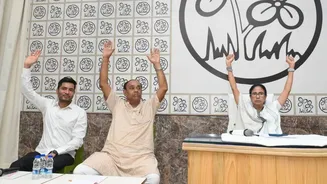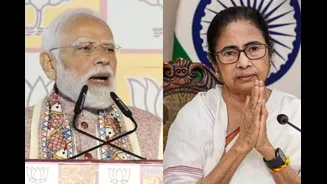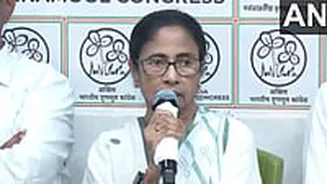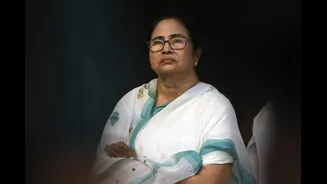







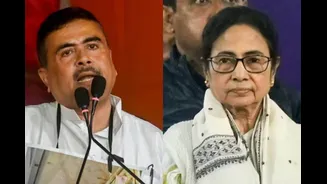
Mamata Banerjee’s dramatic fall in the 2026 West Bengal Assembly elections has altered the state’s political landscape. The Trinamool Congress (TMC), which had dominated Bengal politics since 2011, was
decisively defeated by the Bharatiya Janata Party (BJP), winning barely around 80 seats against the BJP’s commanding 207 tally.
The blow was personal as well as political: Banerjee lost her own seat in Bhabanipur. Yet, even after this drubbing, she has refused to resign as Chief Minister, questioning the mandate and alleging irregularities, setting the stage for a contentious transition of power.
But while the constitutional question of her continuance plays out, the real political test for Mamata, and for the TMC, lies just ahead.
Mamata’s First Real Test: Local Body Elections
The next big battleground in West Bengal is the municipal and panchayat polls. The Kolkata Municipal Corporation (KMC) election is due around December 2026, where all 144 wards will go to polls.
Meanwhile, the next panchayat elections are expected in 2028, following the last cycle held in July 2023.
These local elections are not mere administrative exercises in Bengal. They are political contests that shape grassroots control, patronage networks, and organisational strength, often acting as a barometer of public mood between larger elections.
To understand the stakes, it’s important to look at how the TMC has performed in recent local polls.
Panchayat elections 2023
In the 2023 panchayat elections, the TMC retained overwhelming control. The party won 35,606 Gram Panchayat seats, 6,560 Panchayat Samiti seats, and 877 Zilla Parishad seats. Additionally, the TMC won control of all 20 Zilla Parishads in the state.
It also secured a 51 per cent vote share, while the BJP got 23 per cent.
Yet, the election was marred by widespread violence and allegations of intimidation, with over 50 deaths reported. More importantly, the BJP consolidated itself as the principal opposition at the rural level.
Kolkata Municipal Elections 2021
In the last KMC polls, the TMC won an astonishing 134 out of 144 seats, with over 72 per cent vote share, leaving the BJP with just a handful of wards.
Why 2026–28 Is Different
The upcoming municipal and panchayat polls will be fought under completely different political conditions.
TMC No More In Power
For the first time since 2011, the TMC is no longer the ruling force in the state. That matters because local elections in Bengal are closely tied to control over administration and resources. The ruling party traditionally enjoys a structural advantage.
With the BJP now in ascendance after winning over 45 per cent vote share in the Assembly polls, the balance of power at the grassroots could shift rapidly.
BJP’s expansion into rural Bengal
The BJP’s Assembly election victory was not just urban. It penetrated regions that were once TMC bastions, including minority-dominated districts. In North Bengal, the BJP converted its earlier foothold into dominance, winning 9 of 11 seats in Cooch Behar. The more consequential shift, however, came in minority-dominated districts like Murshidabad, Malda and Uttar Dinajpur. In Murshidabad, the TMC’s tally dropped sharply from 20 of 22 seats in 2021 to 9 in 2026, with the BJP benefiting from a split in votes among the TMC, Congress, Left and smaller parties.
At the same time, the BJP expanded decisively across South Bengal and peri-urban belts, including the Burdwan and Medinipur divisions as well as parts of North 24 Parganas and Howrah. The BJP won 44 of 54 seats in the Burdwan division and an overwhelming 54 of 56 seats in the Medinipur division, regions that combine dense rural networks with politically influential semi-urban clusters.
If that trend sustains, the BJP could challenge the TMC in panchayat networks, which are crucial for long-term political control.
The fear of defections
The key question now is whether the TMC can retain its cadre-based grassroots machinery without being in power. There are already murmurs in political corridors that defections could take place and administrative shifts could weaken its hold before the next rural polls.
For Mamata Banerjee, these elections are more than routine contests. They are a referendum on her political survival. A strong performance in municipal polls would show that urban Bengal still backs her. Holding ground in panchayat elections would prove that her rural base remains intact.
But a poor showing could signal that the 2026 Assembly defeat was not a one-off wave, but the beginning of a structural shift in Bengal politics.
The municipal and panchayat polls will test whether the TMC is still a grassroots force, or whether the BJP’s rise has permanently altered Bengal’s political DNA. In many ways, these local elections will decide whether Mamata’s era is ending, or merely entering a turbulent new phase.