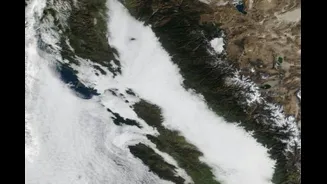








A vast blanket of fog has covered California’s Central Valley for weeks, stretching nearly 400 miles. Scientists say the conditions are ideal for such long-lasting fog with an early wet season, cold winter
temperatures and a stable high-pressure system that has barely moved. However, for meteorologists, this kind of fog is unusual but not alarming. For many people on social media, however, it has become a cause of serious concern.
On social media, users are sharing videos and photos of what they describe as “mysterious” fog. Some claim it feels thicker than normal and contains strange black or white particles. Others have pointed to the scientific term “radiation fog”, wrongly assuming it has something to do with radioactive material.
One widely shared video shows a man wiping condensation from his truck’s grille and finding a white residue on his finger. In the clip, he wonders aloud whether the fog contains asbestos. Another post shows aeroplane contrails crossing the sky above the fog, suggesting suspicious activity overhead. Such posts have fuelled anxiety and speculation across the region.
Happening Now: “A thick layer of radiation fog is covering Central California” “The phenomenon called radiation fog is unrelated to nuclear radiation, but it creates an equally dangerous situation. A thick layer of fog forms when the ground cools rapidly after sunset,…pic.twitter.com/WEaRfcMao0
Happening Now: “A thick layer of radiation fog is covering Central California”
— Wall Street Apes (@WallStreetApes) December 15, 2025
“The phenomenon called radiation fog is unrelated to nuclear radiation, but it creates an equally dangerous situation. A thick layer of fog forms when the ground cools rapidly after sunset,… pic.twitter.com/WEaRfcMao0
What scientists say is really in the fog
Experts say there is material in the fog, but it is far less dramatic than social media suggests. According to fog researchers, the explanation lies in the Central Valley’s poor air quality. The region is known for having some of the worst air pollution in the United States.
Fog droplets are excellent at trapping pollutants. They remain suspended in the air for long periods and have a large surface area, allowing them to absorb gases and tiny particles from the atmosphere. These can include emissions from vehicles, agricultural chemicals, industrial pollution and wood smoke from fireplaces.
Northern California resident says they have been having really heavy fog that “has sh*t in it” He shows on his truck there is a thick film where he’s driven through the fog, showing this doesn’t seem like normal fog Reports in Southern California are confirmed “radiation fog”…pic.twitter.com/Cxv4TRU9XY
Northern California resident says they have been having really heavy fog that “has sh*t in it”
— Wall Street Apes (@WallStreetApes) December 16, 2025
He shows on his truck there is a thick film where he’s driven through the fog, showing this doesn’t seem like normal fog
Reports in Southern California are confirmed “radiation fog”… pic.twitter.com/Cxv4TRU9XY
Why the fog can feel sticky?
Some people have reported that fog residue turns into a jelly-like substance when left to sit. Scientists say this is also not surprising. Fog can collect biological material such as fungal spores, algae and other airborne particles. When these mix with water droplets, they can create a sticky or gelatinous texture.
Health risks
Researchers say the main way people are exposed to these pollutants is through breathing them in. The good news is that fog droplets are relatively large, so they do not usually travel deep into the lungs. This makes them less harmful than the fine particles found in dry, polluted air.
There is more concern about ingestion. Fog can settle on vegetables, fruit and open water containers. Experts advise washing produce thoroughly and cleaning anything left outdoors before eating or drinking from it.
When will the fog clear?
Meteorologists expect an incoming storm system to push the fog away soon. However, if high-pressure conditions return later in winter, the Central Valley could once again find itself wrapped in a cold, dirty layer of fog.