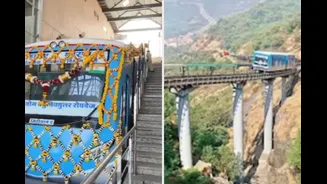





The much-awaited funicular railway or Switzerland-like cable cars at Malanggad or Haji Malang near Kalyan in Thane district, on the outskirts of Mumbai, are now operational. With this modern railway, the two-hour
walking journey of Muslim and Hindu devotees visiting the Haji Malang dargah will now be completed in just 7-10 minutes. The funicular railway is expected to boost tourism in the region.
Haji Malang or Malanggad in Sahyadris
Malanggad in Thane district is a shrine popular among devotees of all faiths. The two-hour trek of nearly 2,600 steps in the Sahyadri mountain range was especially difficult for senior citizens, women and children. Keeping this difficulty in mind, then MLA of Ambernath, Kisan Kathore, had proposed to start a funicular railway on Malanggad on the lines of Switzerland.
The construction began in 2012 and was completed last year.
।। ॐ नमो श्री मलंग मत्स्येंद्राय ।।
श्री मलंगगडाच्या चरणी कोटी कोटी नमन!#ShriMalanggad #FunicularRopeway #MLA #sulbhaganpatgaikwad #kalyaneast pic.twitter.com/GGFhA8hzz0— Sulbha Ganpat Gaikwad (@sulbhagaikwad7) January 18, 2026
The project was slated to be completed in 2015, with a budget of ₹93 crore. However, due to the steep and uneven terrain of the Malanggad hill in several stretches, the construction of India’s longest funicular railway in Kalyan posed many challenges and was thus delayed.
The inauguration was delayed by nearly a year due to pending safety clearances and technical approvals.
The railway was inaugurated by MLA Sulbha Ganpat Gaikwad and Kishan Kathore.
What is funicular railway?
It is a specialised cable-driven transportation system designed to move passengers or cargo up and down steep slopes. Its name is derived from the Latin word funiculus, meaning “small rope”. The system typically features two counterbalanced carriages permanently attached to opposite ends of a single haulage cable.
As one car ascends, the other descends simultaneously. The weight of the descending car helps pull the ascending car up, significantly reducing the energy needed to overcome gravity.
Most modern systems use an electric motor at the top station to drive a large pulley (bullwheel) that moves the cable. Historically, some were powered by water ballast, filling tanks in the top car until it was heavy enough to pull the bottom car up.
Designs range from four parallel rails to “two-rail” systems that share a single track except for a passing loop at the midpoint where the cars can pass each other.
How it will operate
Two funicular trains will run on this route, each with two spacious coaches.
Around 1,200 passengers will be able to travel every hour through this service.
The management of Supreme Suyog Funicular Ropeways Company told News18 Marathi they are trying to continue this service 24 hours a day after seeing the response of the devotees.
Around 70 employees have been deployed for this entire arrangement.