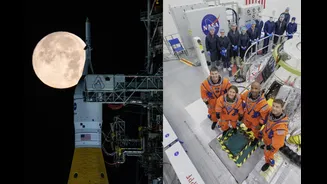









As NASA prepares for its highly anticipated Artemis II moon mission launch, the four astronauts who are preparing for the flight will be wearing bright orange spacesuits. There is a reason for this striking
colour choice and no it wasn’t a fashion one but rather a thoughtful blend of engineering, safety, and human-centred design.
The crew — Reid Wiseman, Victor Glover, Christina Koch, and Jeremy Hansen, will not be landing on the Moon on this mission. Instead, under NASA’s Artemis II programme, they will travel roughly 600,000 miles around it before heading back to Earth at speeds reaching nearly 30 times the speed of sound.
These suits, officially known as the Orion Crew Survival System or OCSS are is in the colour ‘international orange’ which is highly visible and unmissable.
Why Are Artemis II Astronauts Wearing Orange Spacesuits?
The orange spacesuits that will be worn by the Artemis II team are in a vivid reddish-orange shade widely used across aerospace and marine industries for one key reason- visibility.
Its intensity ensures it stands out clearly, even in low-light or challenging conditions. It’s meant to be worn during launch and entry and has been “enhanced from head to toe with improvements to the suit worn on shuttle missions,” according to NASA.
These orange suits are built for extreme scenarios and if the Orion spacecraft were to lose cabin pressure in space, these suits can help keep the astronauts alive for up to six days.
View this post on Instagram
They are also designed with the return journey in mind, featuring built-in survival gear to support astronauts during an ocean splashdown and the moments that follow.
Each astronaut carries a life preserver along with tools such as a personal locator beacon, signalling devices, and even a rescue knife. There is a quiet reassurance in knowing that every astronaut is essentially carrying a compact emergency kit tailored for space and sea alike.
When is The Artemis II Launch?
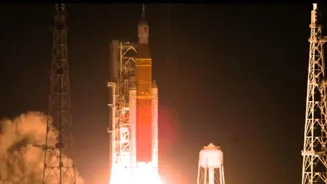
NASA’s Artemis II mission, carrying a four-astronaut crew, successfully launched yesterday i.e. 1 April, 2026 at 6:35 pm EDT (22:35 GMT) from Kennedy Space Center’s Launch Complex 39B in Florida, USA.
NASA’s live mission coverage can be seen on its official Youtube channel.
The crew — NASA astronauts Reid Wiseman, Victor Glover and Christina Koch and Canadian Space Agency astronaut Jeremy Hansen — won’t be landing on the moon. Instead, they’ll venture 600,000 miles around the moon and will return at 30 times the speed of sound, according to NASA.
Over the course of the 10-day journey, the team will focus on testing critical life-support systems aboard the Orion capsule, laying the groundwork for future crewed missions that will eventually attempt a lunar landing. That milestone is currently planned for Artemis III, targeted for launch in 2027.
Adding a lighter touch to the mission, the astronauts will be accompanied by a small mascot named Rise. Designed by Lucas Ye, a second-grade student from California, the toy will float inside the capsule to signal when the spacecraft has entered zero gravity.
Fist bump, Rise!
Very emotional moment zipping up Rise, knowing we are bringing 5,647,889 names with us on this journey around the Moon. For all!
People from around the world submitted their names through the Send Your Name with Artemis campaign.
These names were downloaded… pic.twitter.com/gKxvrHw7M0
— Reid Wiseman (@astro_reid) March 29, 2026
The design was chosen from more than 2,600 entries submitted by participants across over 50 countries, making it a small but meaningful global contribution to the mission.