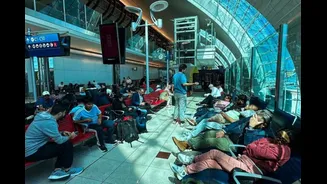








A “perfect storm” of technological transitions, peak demand, and severe weather has plunged European air travel into chaos this week. Hundreds of travelers remain stranded across the continent as major
airlines, including Lufthansa, KLM, and Finnair, struggle to navigate a surge in delays and cancellations
1,720 Flight Delays And Counting
According to recent operational data, the scale of the disruption is staggering. In a single 24-hour window, 1,720 flights were delayed and 61 were cancelled across key hubs in the Netherlands, the UK, and Italy.
The crisis reached a breaking point at Milan Linate Airport, where an easyJet flight to Manchester was forced to depart with 122 passengers left behind. Despite arriving more than three hours early, the travelers were trapped in passport control queues that reportedly stretched to three hours, with witnesses describing scenes of passengers fainting in overcrowded, sweltering terminals.
EU’s New Entry-Exit System (EES)
While staffing shortages and North Sea weather systems have played a role, the primary driver of the current gridlock is the full rollout of the EU’s Entry/Exit System (EES).
It is a digital border regime that replaces traditional passport stamping with biometric checks (fingerprints and facial scans) for non-EU citizens, including those from the UK. The Airports Council International (ACI) reports that processing times have skyrocketed. What used to take seconds now takes minutes per passenger, leading to “unmanageable” queues at major gateways in France, Germany, Belgium, Italy, Spain, and Greece.
Aviation bodies are now calling for the power to suspend EES checks during peak periods to prevent total terminal paralysis.
What Travellers Need To Know
If you are heading to Europe this summer, the landscape has changed. Here is how to navigate the turbulence:
Arrive Earlier (But Head Straight to the Border)
Standard “two hours before” advice may no longer suffice. Travel experts and ABTA recommend arriving at least three to four hours early and heading immediately to passport control after clearing security. The EES registration—required on your first entry since the system went live—is a one-time process that lasts for three years, but the initial setup is the current bottleneck.
Know Your Rights (EC 261/2004)
Under European law, if your flight is delayed or cancelled, airlines have specific obligations:
- Duty of Care: Airlines must provide food, refreshments, and, if necessary, overnight accommodation and transport.
- Rebooking: You are entitled to be rerouted to your final destination at the earliest opportunity.
- Compensation: You may be eligible for up to €600 if the delay is within the airline’s control. Note: Airlines are currently arguing that EES delays are “extraordinary circumstances,” but reports suggest management issues may still trigger eligibility.
- Prepare For “ETIAS” Later This Year: The EES is just the first step. By late 2026, the ETIAS (European Travel Information and Authorisation System) will launch, requiring non-EU travelers to apply for a €7 visa-waiver before they even arrive at the airport.
- Always keep receipts for any out-of-pocket expenses (food, hotels, alternative transport) incurred during a delay. Most airlines will require these for reimbursement claims.