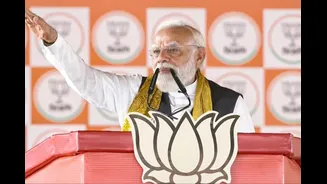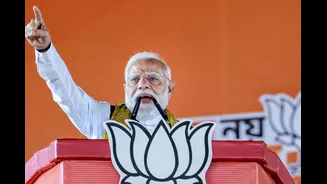







Prime Minister Narendra Modi on Thursday declared that a “storm of poribortan” (change) is sweeping across West Bengal, stressing the state is on the cusp of a historic political transformation.
Addressing
a massive public rally in the industrial hub of West Bengal’s Haldia, Prime Minister Modi described the upcoming assembly elections as an opportunity to dismantle the “nirmam sarkaar” (cruel government) of the Trinamool Congress (TMC) and restore the state’s former glory.
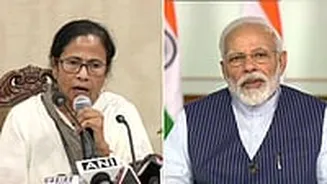
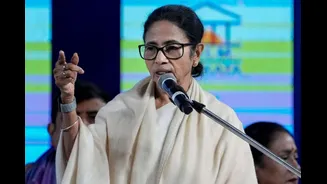
Modi pointed to the surging enthusiasm of the crowds as a sign of the BJP’s impending victory. Drawing on opposition leader Suvendu Adhikari’s “miracle” victory in Nandigram five years ago, he predicted a repeat performance for him in Bhabanipur, where is once again up against Chief Minister Mamata Banerjee.
“I have seen that this time Bengal has decided to defeat every adverse situation. BJP’s victory is visible in this enthusiasm and excitement. This is a storm of poribortan (change). This is the announcement of the departure of the nirmam sarkaar of TMC. Medinipur and Nandigram showed the path of change five years ago, and now the entire West Bengal has started walking on that same path of transformation. The miracle that Nandigram did five years ago is going to be repeated in Bhabanipur this time, and across the whole of Bengal,” Modi said.
He highlighted the BJP’s significant leap to 77 seats despite the TMC’s landslide victory of 213 seats in the 2021 assembly polls. He said the electorate is increasingly disillusioned with the status quo and ready for new leadership, but for that the departure of the current regime is an essential first step towards building a “developed Bengal”.
WHAT IS THE NANDIGRAM ‘MIRACLE’ REFERENCE?
Modi’s reference to the Nandigram “miracle” was his way to draw parallel between that electoral contest and the one set to take place in South Kolkata’s upscale Bhabanipur – it will be another Suvendu Adhikari versus Mamata Banerjee showdown.
Adhikari had defeated Banerjee in Nandigram by at least 9,000 votes in 2021. Modi said the Nandigram battle will be repeated in Bhabanipur this time.
He said Bhabanipur, long considered a TMC bastion, is now the frontline of a straightforward clash that symbolises the broader desire for change across Bengal. He stressed the path of transformation shown by Medinipur and Nandigram, which is now being followed by the entire state.
THE ‘FISH’ JAB: WHAT DOES IT MEAN?
Modi launched a scathing attack on Bengal’s economic decline, specifically highlighting the industrial decay in Haldia.
Amid a raging vegetarian/non-vegetarian debate, he specifically addressed the failure of the fishing industry in Bengal. He said a state with such high demand for fish is compelled to import it from elsewhere.
The PM pointed out that while national fish production and seafood exports have doubled over the last 11 years, Bengal has remained stagnant due to “misguided policies”. He contrasted this with BJP-governed states like Bihar and Assam, where fish production has doubled allowing them to transform from importers to exporters.
“Another immense opportunity in West Bengal lies in fish farming — in fisheries and seafood… Despite the immense demand for fish here in Bengal, the state remains far from self-reliant in fish production. Even today, Bengal is compelled to import fish from other states to meet its domestic requirements. Even after 15 years in power, the TMC has failed to provide you with even something as basic as fish; that, too, must be sourced from outside the state. This stands as a glaring example of the TMC’s misguided policies. Over the last 11 years, India’s overall fish production has doubled. India’s seafood exports have doubled. Yet, here in Bengal — solely due to the TMC government — what was successfully achieved across the rest of the country failed to materialise,” he said.
He said the TMC government has even obstructed central welfare schemes like the PM Matsya Sampada Scheme because they find the “PM” prefix “distasteful”. He said this arrogance has directly harmed the livelihoods of lakhs of fishermen who could otherwise benefit from the Kisan Credit Card scheme and insurance coverage.
Modi further said the region, which encompasses the historic port city of Tamralipta, has seen its factories shut down in recent decades while “the shops of rioters and criminals have thrived”. He attributed this stagnation to a “syndicate-driven” system where no investment or developmental work can proceed without the payment of “cut money” or commissions.
“The Bengal that once formed the foundation of India’s progress, that strengthened India’s manufacturing and trade, has been brought down so much on all development parameters by TMC. Who knows this situation better than Medinipur and Haldia? Centuries ago, the historic Tamralipta was a flourishing port city where trade happened with the entire world. Haldia was one of the major industrial centres of modern India. But in recent decades, factories in Haldia have shut down,” he said.
PM MODI’S 6 GUARANTEES FOR BENGAL: WHAT ARE THEY?
Modi unveiled “six guarantees” intended to establish an “accountable and fully answerable” BJP government. These promises are designed to address issues of corruption and the breakdown of the rule of law that he claimed have defined the TMC’s tenure.
His first two guarantees focused on restoring public trust by replacing the current “atmosphere of fear” with the rule of law and ensuring the administration serves the people. His third and fourth guarantees took a hardline stance on justice, promising to reopen files on every scam, act of corruption, and crime against women, including cases of rape.
“Under the TMC’s rule, whoever has engaged in corruption belongs in jail,” he said, adding that no “TMC goon” or official, regardless of their rank, will be able to evade the law.
The fifth guarantee addressed the contentious issue of migration, promising that while refugees will be granted their constitutional rights, “infiltrators” will be driven out. In a significant move for state employees, the Prime Minister’s sixth guarantee promised the immediate implementation of the 7th Pay Commission upon the formation of a BJP government.
(With agency inputs)