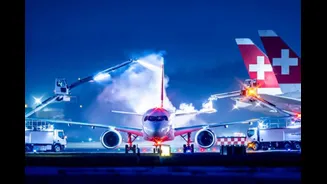








France, Germany, Switzerland, and much of Europe are enduring severe cold at the moment. On Wednesday, January 7, 2026, Zurich Airport (ZRH) appeared blanketed in white. Temperatures have plunged well
below zero, leaving Swiss Airlines aircraft coated with thick layers of ice.
In such harsh conditions, planes must undergo a crucial procedure before taking off, known as de-icing. Without it, no aircraft is permitted on the runway.
Airports In Europe Face Icy Challenges
Ice on the wings is an invisible threat in the sky. Aircraft wings and control surfaces are engineered to allow smooth airflow, generating lift. When ice forms, it blocks airflow, adds weight, and severely impairs flight performance. Attempting take-off with icy wings is extremely dangerous. Aviation experts note that even a few millimetres of ice can reduce lift by 30% and increase drag by 40%, forcing engines to work harder to keep the plane airborne.
At airports like Zurich, where heavy snowfall is common in January, ice can also accumulate on sensors such as the pitot tube, giving pilots incorrect readings. Historical accidents have shown that failing to de-ice, or performing it improperly, can have catastrophic consequences. That is why airlines like Swiss Airlines prioritise safety above all else.
How De-Icing Works At Zurich Airport
De-icing is not merely about removing ice, it ensures the plane is fully stable. Aircraft departing from Zurich must climb thousands of feet within minutes, where temperatures are even lower. Therefore, planes must be thoroughly cleaned before take-off.
The procedure takes place on specialised de-icing pads. Large crane-like vehicles, called de-icing trucks, surround each plane.
- De-icing: A mixture of hot water and propylene glycol, known as Type 1 fluid, is sprayed over the aircraft. This orange-coloured liquid melts the ice immediately and allows operators to see which parts remain coated.
- Anti-icing: If snow continues to fall, a second spray called anti-icing is applied. This uses Type 4 fluid, a green, jelly-like substance that forms a protective layer over the wings, preventing new ice from forming while taxiing or during take-off.
Today, dozens of de-icing teams work around the clock at Zurich Airport. Depending on the thickness of ice, the process takes between 5 and 15 minutes per aircraft.
Swiss Airlines has warned passengers that flights may be delayed due to de-icing, but safety always comes first.
Zurich Airport has a dedicated drainage system to collect and recycle the glycol mixture, ensuring it does not harm the environment. So next time you see coloured fluid being sprayed from your window, know it is a safety shield, protecting your flight from icy hazards.