








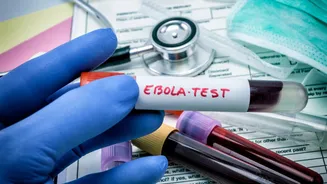

Health authorities in Hyderabad swiftly isolated a Sudanese national after he was detected with fever upon arrival at the Rajiv Gandhi International Airport (RGIA) early on Thursday, triggering heightened
vigilance amid global concerns over the ongoing Ebola outbreaks in parts of Africa.
The passenger, according to The Hindu, a man in his 30s, arrived from Ethiopia and had recent travel history to Uganda and South Sudan regions reporting Ebola activity. He was identified during routine thermal screening by the Airport Health Officer (APHO) as part of enhanced surveillance measures for international arrivals.
According to the report, the traveller had been experiencing fever for the past two to three days but did not exhibit other symptoms commonly associated with viral haemorrhagic fevers. As a precaution, he was immediately isolated and shifted to Gandhi Hospital in Secunderabad, the designated Ebola nodal centre in Telangana.
Health officials have repeatedly clarified that the case is not being treated as a confirmed or even suspected Ebola infection at this stage. The referral was made purely as a precautionary measure due to his travel history and detected fever.
Samples, including oral and nasal swabs, have been collected and sent for testing. While some reports mention samples being despatched to the National Institute of Virology (NIV), Pune, media reports noted that they were sent to the nearby Centre for Cellular and Molecular Biology (CCMB) one of the ICMR-authorised labs with results expected within 48 hours.
This incident comes against the backdrop of active Ebola outbreaks in the Democratic Republic of Congo and Uganda. India has been maintaining strict airport surveillance and preparedness protocols across major entry points following directives from the Union Health Ministry.
Authorities have assured that all standard public health protocols, including contact tracing if required, are in place. The patient remains comfortable and is being provided supportive care while awaiting laboratory confirmation.
Public health experts urge calm, stressing that timely screening and isolation demonstrate India’s proactive approach to preventing any potential importation of the virus. As test results are awaited, this case serves as a reminder of the importance of robust travel surveillance in an interconnected world.
What is Ebola?
Ebola was first identified in 1976 in Africa, near a river of the same name. It belongs to a family of viruses called filoviruses. Six species of ebolavirus are known, though only four are known to cause illness in humans. Three — Zaire, Sudan, and Bundibugyo, are responsible for nearly all major outbreaks.
The virus naturally lives inside fruit bats, which carry it without falling sick themselves. The trouble starts when humans come into contact with these bats by hunting them for meat, entering caves or mines where they live, or handling other animals such as monkeys and forest antelopes that the bats may have infected.
Is India Prepared?
Airports in Delhi, Mumbai, Bengaluru, Chennai, Kolkata, Hyderabad, Kochi and Thiruvananthapuram have thermal screening and isolation facilities. Major hospitals also have designated Ebola isolation wards on paper.
The swift detection and isolation of the Sudanese national at Hyderabad Airport, followed by immediate transfer to Gandhi Hospital the designated Ebola nodal centre demonstrate strong surveillance protocols.
Enhanced thermal screening at international airports, rapid sample testing at ICMR-authorised labs, and clear contact-tracing readiness reflect lessons learned from previous outbreaks.
While vigilance remains crucial, the proactive response highlights India’s improved public health infrastructure and preparedness against imported viral threats.