









Since the United States and Israel launched strikes on Iran on February 28, the Strait of Hormuz has been at the centre of the widening geopolitical confrontation. Iran responded to the attacks by tightening
control over shipping movements through the narrow waterway, while US President Donald Trump later escalated matters further by announcing a naval blockade targeting Iranian-linked vessels and ports.
Over the past three months, the strait has witnessed repeated stand-offs involving naval escorts, drone attacks, missile interceptions, stranded commercial tankers and competing claims over who controls safe passage through one of the world’s most critical trade arteries. Hundreds of ships were trapped in Gulf waters at one stage, insurance costs surged, and global markets braced for a prolonged disruption to oil supplies.
But as the conflict deepened, another vulnerability began attracting attention beneath the waters of Hormuz, not oil tankers, but internet cables.
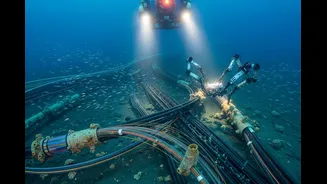
Iranian state-linked media and figures associated with the Islamic Revolutionary Guard Corps (IRGC) have increasingly signalled that Tehran may seek greater control over the undersea fibre-optic cables running through and around the Strait of Hormuz. These submarine cables carry much of the world’s digital traffic — including cloud computing data, financial transactions, AI workloads and communications handled by companies such as Google, Meta Platforms, Amazon and Microsoft.
The New Chokepoint Isn’t Oil. It’s Data
The modern internet does not primarily run on satellites. Nearly all global internet traffic travels through fibre-optic cables laid across the ocean floor. These undersea cables handle everything from WhatsApp calls and Google searches to stock trades and cloud computing operations.
Several major intercontinental submarine cables pass through or near the Strait of Hormuz, making the region one of the world’s most sensitive digital chokepoints.
Iranian outlets linked to the IRGC have argued that because these cables traverse waters close to Iran, Tehran should be able to levy charges, regulate operators and even oversee repair and maintenance work. Some reports have gone further, warning that cable traffic could face disruption if companies refuse to cooperate.
Until now, Hormuz was viewed mainly as an energy pressure point. Tehran is increasingly signalling that it sees digital infrastructure as another strategic lever against the West.
Why Big Tech Is Vulnerable
Over the last decade, Big Tech companies have quietly become some of the world’s largest owners and operators of subsea cable infrastructure. Google, Meta, Amazon and Microsoft now collectively finance or control massive portions of global internet bandwidth through private cable networks and cloud infrastructure investments.
The reason is simple: owning cables means controlling speed, reliability and data movement for their cloud empires.
Any disruption in Gulf cable routes would not just slow social media, but could affect cloud servers, banking systems, logistics networks, financial markets and enterprise communications across continents. This is why analysts increasingly describe subsea cables as “critical infrastructure” on par with pipelines and power grids.
Why The Strait Of Hormuz Matters Digitally
Most people imagine internet traffic floating invisibly through the air. In reality, it travels through extremely physical infrastructure.
The Gulf region sits at the crossroads of Europe, Asia and the Middle East. Many data routes connecting Asia to Europe either pass through the Red Sea corridor or through Gulf-linked networks near Hormuz.
India is particularly exposed. Reports suggest that a significant portion of India’s internet traffic to Europe passes through submarine cable systems linked to Gulf and Red Sea routes. Any disruption could slow cloud services, financial systems and online platforms used by millions.
The Gulf is also becoming a major AI and data-centre hub. Countries like the UAE and Saudi Arabia are investing heavily in hyperscale cloud infrastructure backed by American tech giants. Those facilities depend on uninterrupted fibre connectivity beneath regional waters.
In other words, the same region that powers the world’s oil economy is increasingly powering its digital economy too.
Can Iran Actually Control These Cables?
International maritime law generally protects submarine cable operations, and many of the major cable systems are operated by multinational consortia. Analysts note that much of the infrastructure has historically been routed carefully to avoid Iranian territorial waters where possible. Still, even limited disruption can create outsized panic.
Undersea cables are notoriously difficult and expensive to repair. Maintenance ships need permissions, access windows and stable security conditions. In conflict zones, repairs can take weeks. That means Tehran may not need to “cut the internet” outright to create leverage. Mere threats, delays or regulatory uncertainty could increase insurance costs, complicate cable maintenance and force companies to rethink routing strategies.
Some experts also believe Iran’s messaging may be partly psychological — a way of demonstrating that Western technological dependence has physical vulnerabilities.
The world has spent decades worrying about who controls oil chokepoints. It may now be entering an era where control over data chokepoints matters just as much. And beneath the waters of Hormuz, those two worlds — energy and information — are beginning to collide.