








In a major breakthrough for Indian astronomy, scientists have discovered a massive galaxy that existed when the universe was just 1.5 billion years old, challenging current ideas about how galaxies formed
soon after the Big Bang.
Since the universe is about 13.8 billion years old, this means we are seeing a galaxy from nearly 12 billion years ago, when the universe was only one-tenth of its current age.
According to the scientists, galaxies that formed so early were found to be mostly irregular in shape and chaotic.
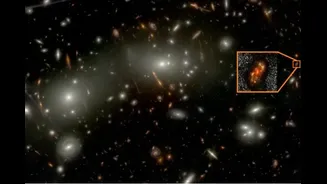
But when researchers Rashi Jain and Yogesh Wadadekar used James Webb Space Telescope (JWST) to peer into the Universe’s early past, they spied a “fully-formed spiral galaxy – a massive, beautifully structured cosmic pinwheel”.
Their research was published in the leading European journal Astronomy and Astrophysics in November.
“The galaxy looks remarkably similar to our own Milky Way, despite being present when the universe was only 10% of its current age,” said Prof Wadadekar, adding that they’ve named it Alaknanda after a Himalayan river.
Jain, a PhD researcher at the Pune-based National Centre for Radio Astrophysics of the Tata Institute of Fundamental Research (NCRA-TIFR) spotted the galaxy was spotted earlier this year, BBC reported.
Jain said she was “really excited” when she spotted the galaxy while poring over the data and images from James Webb, the $10bn telescope launched jointly by the US, European and Canadian space agencies in 2021.
“I had been looking at details of 70,000 objects and there was only one there that was a grand design spiral galaxy, spanning approximately 30,000 light-years in diameter,” she said.
In simple terms, the galaxy had two matching arms extending from a central disc and curving around a bright core, she explains.
“We could see the typical ‘beads-on a-string’ pattern which is like clusters of stars along the spiral arms, similar to what we see in nearby spiral galaxies today.”
When she shared the finding with her supervisor, Prof Wadadekar, he was initially in disbelief. “It’s astonishing how such a large galaxy with spiral arms could have existed just 1.5 billion years after the Big Bang,” he told the BBC.
“This galaxy had to assemble 10 billion solar masses of stars and simultaneously form a large disc with spiral arms in just a few hundred million years. That’s incredibly rapid by cosmic standards,” he said.
Prof Wadadekar said that this galaxy is one-third of the Milky Way in size, and has 10 billion stars.
“But this galaxy is a different beast. It’s massive, it’s one-third of the Milky Way in size, and has 10 billion stars. The galaxy is forming new stars at a rate that’s roughly 20-30 times faster than our Milky Way’s current star formation rate,” he said.
In recent years, the Webb telescope has found more complex structures, including spiral galaxies, and this new discovery adds to growing evidence that the early universe was far more advanced than once believed.
“This galaxy shows that Universe was much more mature early on and that sophisticated structures were being built in our universe much earlier than we thought possible,” Jain said.