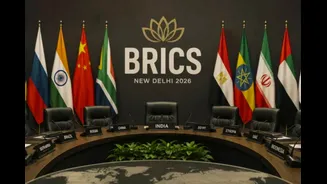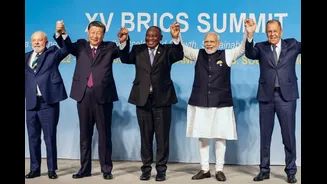






BRICS Summit 2026: The push to reduce dependence on the US dollar is once again expected to feature prominently as BRICS leaders gather in New Delhi for the much-anticipated summit this weekend.
The 2025
BRICS Declaration stopped short of directly mentioning the US dollar but called for finding “acceptable mechanisms of financing in local currencies” — a move widely seen as part of the bloc’s broader efforts to reduce reliance on the dollar in cross-border trade and finance.
Also Read | Message To Trump? India To Debate De-Dollarisation With Allies At BRICS Summit 2026
The US dollar has dominated global reserves and international trade for more than eight decades. However, growing use of financial sanctions by Washington has prompted several countries to explore alternatives.
Following Russia’s invasion of Ukraine, the G7 froze around $300 billion of the Russian central bank’s foreign-exchange reserves and major Russian banks were cut off from the SWIFT international payments system.
The measures accelerated Moscow’s efforts to reduce its dependence on Western financial systems. Russia’s trade with China has since crossed $240 billion annually, with more than 90% of bilateral trade reportedly being settled in Chinese yuan and Russian roubles rather than dollars or euros.
What Did BRICS Say About The US Dollar?
The BRICS declarationdid not explicitly call for replacing the US dollar as the world’s dominant currency.
Instead, the 2025 summit statement said BRICS leaders welcomed the focus of the BRICS Interbank Cooperation Mechanism on facilitating and expanding innovative financial practices and approaches for projects and programmes.
It also backed efforts to find “acceptable mechanisms of financing in local currencies”.
The language reflects the bloc’s broader push to increase the use of national currencies in trade and financial transactions, without formally proposing a common BRICS currency or an outright replacement for the dollar.
What Is India’s Stand On De-Dollarisation?
While Russia and China have been among the strongest advocates of reducing dependence on the dollar, India has maintained a more cautious position.
External Affairs Minister S Jaishankar had said last year that replacing the US dollar was not India’s policy.
“I don’t think there’s any policy on our part to replace the dollar,” Jaishankar said, stressing that the dollar’s role as the world’s reserve currency contributes to international economic stability.
He also pointed out that there was no unified BRICS position on de-dollarisation, particularly after the bloc’s expansion.
India, he said, believes that working with the United States and strengthening the existing international financial and economic system should remain a priority.
This puts New Delhi in a somewhat different position from Moscow and Beijing. India has supported greater use of local currencies and mechanisms that can make international payments more resilient, but it has not advocated replacing the dollar as the world’s primary reserve currency.
Why Is Donald Trump Angry With BRICS’ De-Dollarisation Push?
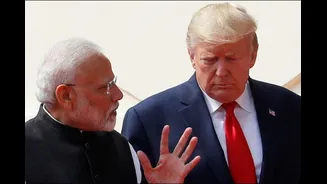
The prospect of BRICS reducing its dependence on the US dollar has drawn a strong reaction from US President Donald Trump.
Trump has repeatedly warned BRICS countries against attempting to challenge the dollar’s dominance and has threatened countries in the bloc with tariffs of up to 100%.
“The Dollar is king. We are going to keep it that way,” Trump has said.
He has also accused BRICS of trying to undermine the dollar’s global position, arguing that any attempt to replace it would threaten US economic power.
Trump has previously compared losing the dollar’s reserve-currency status to “losing a World War”.
At the same time, Trump has promoted measures aimed at strengthening the dollar and maintaining its central role in the global financial system.
Can BRICS Really Replace USD?
Despite the growing use of local currencies among BRICS members, replacing the US dollar remains a far bigger challenge.
The dollar continues to play a central role in global trade, foreign-exchange markets, international finance and central-bank reserves. BRICS members also have different economic interests and monetary policies, making a unified alternative to the dollar difficult to establish.
For India, the issue is therefore less about choosing between the dollar and BRICS and more about maintaining strategic flexibility.
As BRICS leaders meet in New Delhi, the key question may not be whether the bloc can replace the dollar, but how far its members are willing to go in reducing their dependence on it — and where India draws the line.