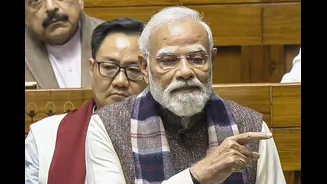

Prime Minister Narendra Modi on Monday opened a commemorative Lok Sabha debate on the 150th anniversary of ‘Vande Mataram’ with a pointed attack on Jawahar Lal Nehru, accusing India’s first prime minister
of aligning with Muhammad Ali Jinnah’s objections to the national song and setting the stage for what he called the Congress’s decades-long “discomfort” with it.
Invoking the Emergency imposed 50 years ago by former prime minister Indira Gandhi, PM Modi drew a direct historical parallel to explain how the Congress took the sting out of the rallying cry. “When ‘Vande Mataram’ celebrated its 100th anniversary, the country was entangled in the Emergency… when it celebrated its 100th anniversary, the Constitution was strangled. Now, at 150 years, it is a good opportunity to restore the glory of ‘Vande Mataram’ which won us freedom in 1947.”
Targeting yet another predecessor, the prime minister turned the spotlight on Nehru for having followed Jinnah in opposing ‘Vande Mataram’ because it could “irritate Muslims”.
#VandeMataram | Congress supported Vande Mataram. Congress gave importance to Vande Mataram to make it the national song of India. PM Modi takes Nehru Ji's name and Congress' name in every debate: Gaurav Gogoi, Congress#Parliament #VandeMataram150 pic.twitter.com/jVdkuXWkPd
— News18 (@CNNnews18) December 8, 2025
PM Modi said “some forces” had carried out “vishwas ghaat” (betrayal) of the national song in the last century, triggering chants of “shame, shame” in the Lok Sabha. “It is our duty to tell our next generations who did it,” he said. “Muslim League (pre-Independence) led by Mohammed Ali Jinnah, in 1937, carried out a drive against Vande Mataram. But the Congress and Jawaharlal Nehru, rather than opposing them, started probing Vande Mataram instead.”
He added: “Within five days of Jinnah’s protest of 1937, Nehru ji wrote to Subhas Chandra Bose that the Anand Math context of the song can irritate Muslims. The entire country was shocked. Yet, on October 26 that year, the Congress made a compromise and divided Vande Mataram into parts. And the excuse was that ‘this is for communal harmony’.”
Accusing the Congress of indulging in the “politics of appeasement” by accepting the removal of some stanzas from ‘Vande Mataram’, PM Modi said it led eventually to a “compromise of the partition of India”. “The Congress continues the same policy. It seems INC (Indian National Congress) has become ‘MMC’,” he said, referring to his recent coinage “Muslim League Maowadi Congress”.
‘WAR CRY AGAINST BRITISH’
Opening the 10-hour discussion, the prime minister emphasised the song’s role in India’s anti-colonial struggle, noting that ‘Vande Mataram’ composer Bankim Chandra Chattopadhyay had crafted it as a direct challenge to British rule. “Vande Mataram was a war cry against the British. The song was response to ‘Long Live The Queen’,” he said. He added: “When we say ‘Vande Mataram’, it reminds us of our Ved Kaal. It says this land is my mother and I am a son of this land. Vande Mataram is a song for motherland.”
PM Modi said the British were forced to ban ‘Vande Mataram’ and “they brought in laws to prevent printing and propagation of the poem”.
Referencing Bengal, he said: “Bengal became a laboratory for the British colonial regime’s ‘divide and rule’ policy. When they committed the sin in 1905 (of diving Bengal province), Vande Mataram stood like a rock, became the song of the streets. It inspired people. The British sowed the seeds of division through Bengal, but Vande Mataram became the strand and song for national unity.” He also recited lines in Bangla and Tamil, citing slogans and translations associated with ‘Vande Mataram’.
“We are here to appreciate and accept the debt of Vande Mataram collectively. It is because of this song that we are all here together. It is a sacred occasion for all of us to acknowledge the debt of Vande Mataram… It united the nation from North to South and from East to West. The time has come to unite again and move together with everyone. This song should inspire and energise us to fulfil the dreams of our freedom fighters. We need to reiterate the resolve to make our nation self-reliant and developed by 2047.”