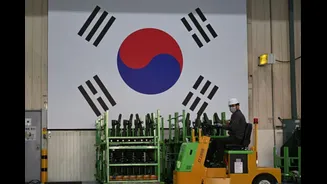








In a potentially positive shift for Indian professionals, South Korea is turning to large-scale immigration to plug widening skills gaps in its economy.
Faced with a rapidly ageing population and one of
the world’s lowest fertility rates, the country has begun rolling out targeted policies to attract foreign talent. The focus is on high-skilled professionals in critical sectors, as well as international students graduating from South Korean universities who can be absorbed into the workforce.
“South Korea’s labour market is highly competitive… there are clear gaps in specialised skills. Employers tend to be cautious and selective, especially with foreign hires. Once placed, roles can be relatively stable and long term. While compensation structures differ from Western markets, the value often lies in technical exposure, innovation driven work, and career continuity. It is a market that rewards preparation, seriousness, and long-term intent,” said Mayank Kumar, CEO & Co-Founder, BorderPlus — a workforce solutions start-up.
As Seoul opens its doors wider than ever before, a key question is emerging in India: does this translate into real job opportunities for Indian workers? If so, which sectors are hiring—and what does South Korea’s immigration rethink reveal about the limits of “demographic advantage” in a globalised world?
Why Has South Korean Made The Shift?
South Korea’s demographic predicament is stark. Fertility rates have plummeted to 0.74 in 2024, some of the lowest in the world, while life expectancy has climbed to a record high of 83.7 years. The result is an ageing population and a shrinking workforce — a combination that threatens long-term economic growth and places immense pressure on pension and healthcare systems.
Historically, South Korea’s immigration stance was conservative, shaped by a desire to preserve cultural homogeneity and social cohesion. Foreign workers were generally limited to low-wage, low-skill roles under temporary programmes, with little prospect of long-term settlement. But the demographic squeeze has forced a rethink. Labour gaps are increasingly appearing in specialised, high-skill areas critical to competitiveness in the global economy.
To confront this, Seoul has begun implementing targeted immigration policies aimed at attracting foreign talent in specific fields. These policies are designed to complement, rather than replace, domestic workers, and they reflect an acknowledgment that demographic advantage, once taken for granted, has limits when it comes to sustaining economic dynamism.
What South Korea Is Targeting
The shift in South Korea’s approach is most noticeable in sectors where labour shortages are deepest and where the domestic workforce is simply not sufficient. These include:
High-Tech and Manufacturing: In 2025, South Korea introduced the ‘Top-Tier Visa’ to attract foreign talent in sectors including semiconductors, biotechnology, secondary batteries, and displays, with robotics and defence to be added. As firms expand, there are gaps in specialised engineering, advanced manufacturing techniques and R&D capabilities. Companies in regions like Gyeonggi and Ulsan have begun recruiting foreign engineers and technical specialists to fill these gaps.
Healthcare and Caregiving: An ageing society means rising demand for medical professionals, aged care workers, physiotherapists and nurses. Domestic supply has not kept pace with demand, leading to unfilled positions in hospitals, clinics and eldercare facilities. Immigration channels targeting healthcare professionals are being adjusted to address these shortages.
IT, AI and Digital Skills: With digital transformation reshaping global economies, South Korean firms are increasingly seeking talent in software development, artificial intelligence, cloud computing and cybersecurity. Start-up ecosystems in Seoul and Busan are also tapping into international tech talent as part of their growth strategies. The E-7 visa category is divided into 87 job categories across IT, business management, finance, and other fields, encompassing a wide range of skilled and semi-skilled occupations.
Education and Research: Universities and research institutes are recruiting international scholars, particularly in STEM fields, to enhance their global competitiveness. Fellowships and research positions with clearer pathways to residency are part of the evolving policy toolkit. The number of STEM majors is at 19% compared to the US, where STEM majors account for 55% among foreign students.
These sector-specific pathways are designed to balance economic needs with social stability. By focusing on areas where skill shortages are well-documented, policymakers hope to attract workers who can immediately contribute and integrate into existing industries.
What It Means For Indian Job Seekers
Around 12,000 to 17,000 Indians live in South Korea, with many working as IT, engineering, and automobile professionals in major companies like Samsung, LG, and Hyundai, according to the Indian Embassy in Seoul and the Ministry of External Affairs.
South Korea’s policy shift presents an emerging opportunity for Indian professionals. For engineers and tech specialists, South Korea’s semiconductor and electronics industries are among the world’s most advanced, and they continue to invest heavily in R&D. Indian engineers with experience in VLSI design, chip fabrication, embedded systems, data science and machine learning may find enhanced prospects in these clusters.
“South Korea seems attractive for engineers working in semiconductors, EVs, robotics, AI, and advanced manufacturing. The ecosystem is demanding and roles are often deeply specialised. From experience, engineers who enjoy solving complex problems and working close to cutting edge production and R&D may find Korea offers exposure that some traditional destinations do not. It is not for everyone, but for certain engineers it can be a strong career move,” said Kumar.
In healthcare, especially nursing and specialised medical services, there is strong demand. Indian nurses and allied health professionals, already sought after in many Western countries, could see new channels opening if credential recognition and language training are strengthened.
IT professionals from India, who already work globally, may find South Korea’s tech start-ups and digital enterprises increasingly receptive, especially if they possess skills in cloud solutions, cybersecurity or AI. The country’s push to internationalise its tech workforce can dovetail with India’s large pool of digitally-skilled professionals.
Finally, academics and researchers in STEM and applied sciences could benefit from research collaborations and university positions as South Korean institutions seek global talent to elevate their international rankings.
“South Korea’s labour challenge looks similar to other ageing economies. Demand exists, but it is selective. For Indian professionals, opportunities appear mainly in engineering, IT, semiconductors, electronics manufacturing, healthcare, and research driven roles. Korean companies are global in outlook but face shrinking domestic talent pools. Indians tend to do well where strong technical skills and adaptability are valued. This is not about mass hiring, but about skilled professionals fitting into specific, high impact roles,” added Kumar.
What Are The Challenges For Foreign Workers?
Despite the promise, working in South Korea is not without challenges for foreign job seekers.
Language Barrier: Korean remains the dominant language in workplaces, especially outside multinational firms. Proficiency requirements can be a barrier for many Indians who are strong in technical skills but lack fluency in Korean.
Credential Recognition: Unlike some Western systems where foreign degrees and experience are more readily evaluated, South Korea’s professional credential systems can be opaque and slow to recognise overseas qualifications in fields like healthcare and engineering.
Social Integration: Cultural adaptation is another hurdle. South Korea’s rapid modernisation has not been matched by multicultural policies, and some foreign workers report social isolation or difficulty accessing community support.
Visa & Settlement Uncertainty: While targeted immigration pathways are expanding, long-term residency and family reunification policies are still evolving. Navigating the D-10 (job-seeking), E-7 (work), and F-2-7 (long-term residence) visa system is complex and restrictive, with high bars for income and academic credentials.
These challenges highlight the gap between policy intent and lived experience. South Korea can open its doors, but integration — linguistic, cultural and social — remains a work in progress.
“In my view, South Korea is not a direct substitute for Western countries, but it can be a credible alternative in specific STEM fields. The country is investing heavily in semiconductors, AI, biotech, and applied sciences, with strong industry and university collaboration. For academics whose work aligns with industrial outcomes, Korea may offer faster translation from research to application. That said, the ecosystem is smaller and more focused, so success depends on niche expertise, adaptability, and openness to a different academic and cultural environment,” pointed out Kumar.
Why Demographic Advantage Is Not Permanent
South Korea’s shift underscores a broader truth: demographic advantage — a large working-age population — is not a permanent competitive edge. It can erode rapidly if fertility rates fall and the population ages, as has happened in much of East Asia.
India, by contrast, currently enjoys a demographic dividend, with a large proportion of its population under the age of 35. This has fuelled growth in sectors from technology to services and allowed India to export skilled labour globally.
South Korea’s pivot thus offers a cautionary lesson: demographic advantage must be paired with continuous investment in skills, education and adaptability. Without these, even a youthful population can struggle to fill modern economic needs.