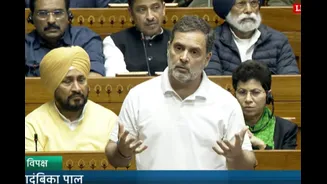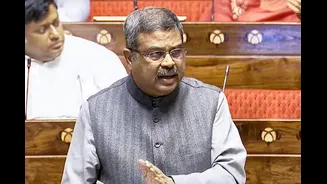









Union Education Minister Dharmendra Pradhan on Monday introduced the Viksit Bharat Shiksha Adhishthan Bill, 2025 in the Lok Sabha to reform the higher education regulatory system and reduce multiple layers
of approvals for universities and colleges.
The Bill aims to empower Higher Educational Institutions (HEIs) in Bharat by ensuring better coordination and uniform standards. It is based on the vision of the National Education Policy (NEP) 2020, which calls for a fundamental overhaul of how higher education is regulated in the country.
The proposed legislation was approved by the Union Cabinet, chaired by Prime Minister Narendra Modi, on December 12, 2025, ahead of its introduction in Parliament.
Single Apex Body For Higher Education
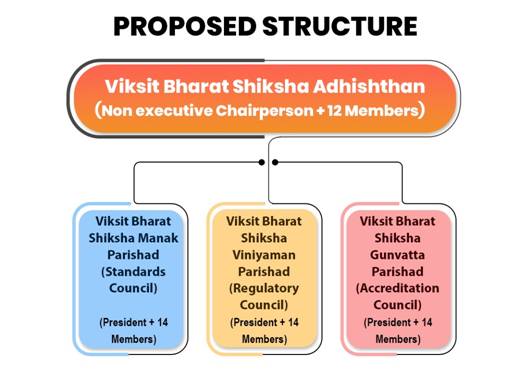
The Bill proposes the establishment of a new apex body called the Viksit Bharat Shiksha Adhishthan, supported by three separate councils. These include the Viksit Bharat Shiksha Viniyaman Parishad as the Regulatory Council, the Viksit Bharat Shiksha Gunvatta Parishad as the Accreditation Council, and the Viksit Bharat Shiksha Manak Parishad as the Standards Council.
If passed, the law will repeal the University Grants Commission (UGC) Act, 1956, the All India Council for Technical Education (AICTE) Act, 1987, and the National Council for Teacher Education (NCTE) Act, 1993.
All higher education institutions currently regulated by UGC, AICTE and NCTE will come under the new Adhishthan for the determination of standards. The Council of Architecture (CoA) will continue to function as a Professional Standard Setting Body, as envisioned under NEP 2020. The Bill also ensures that the existing autonomy of Institutions of National Importance remains unchanged.
Constitutional And Policy Framework
The Bill has been introduced under Entry 66 of the Union List in the Seventh Schedule of the Constitution of India, which provides for “Co-ordination and determination of standards in institutions for higher education or research and scientific and technical institutions”.
Officials said the legislation draws from the vision of NEP 2020, which was drafted under the leadership of Lt. Dr. K. Kasturirangan, former ISRO chairperson. The policy emphasises academic autonomy, multidisciplinary education, research excellence and global competitiveness rooted in Indian values.
The government said global best practices were studied and adapted to suit India’s higher education system, keeping national priorities in focus.
End To Multiple Approvals
Currently, universities and colleges must obtain approvals from multiple regulatory bodies, often undergoing repeated inspections. This has led to over-regulation and duplication of control.
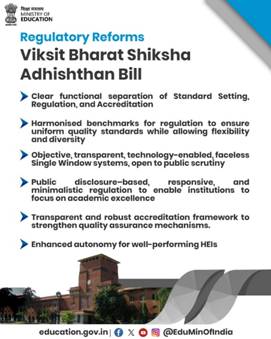
The new Bill proposes a technology-driven, faceless and single-window system based on public self-disclosure and trust-based regulation.
The Regulatory Council will operate a public digital portal where HEIs must disclose details related to governance, finances, audits, infrastructure, faculty, academic programmes and educational outcomes. This information will also serve as the primary basis for accreditation.
ALSO READ: Delhi Schools Switch To Online-Only Classes For Students Up To Class 5 Due To Pollution
Clear Separation Of Roles
The Bill provides a clear separation between standard setting, regulation and accreditation through independent councils.
The Standards Council will define minimum academic standards for HEIs. The Regulatory Council will ensure coordination and compliance with these standards. The Accreditation Council will function as an independent body overseeing the accreditation ecosystem.

The Adhishthan and the councils will largely comprise eminent academicians, domain experts and representatives from States, Union Territories, state universities and Institutions of National Importance.
Student-Centric Reforms
According to the government, the Bill focuses strongly on students and youth empowerment. Transparent systems are expected to improve access to quality higher education and increase the Gross Enrolment Ratio.
Students will be able to provide structured feedback on academic quality, infrastructure, governance and the overall learning experience. This feedback will play a role in institutional evaluation and rankings.
The Bill also promises a fair and transparent grievance redressal mechanism to address student concerns in a timely manner.
Global Outlook And Autonomy
By adapting global best practices, the government aims to enhance the international credibility of Indian higher education institutions and attract foreign students and faculty.
At the same time, well-performing institutions will be given greater autonomy, allowing them to function independently and focus on innovation, research and academic excellence rather than procedural compliance.