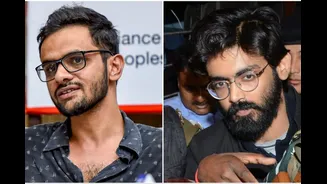







The Supreme Court on Monday denied bail to activists Umar Khalid and Sharjeel Imam in the larger conspiracy case linked to the 2020 north-east Delhi riots, holding that their role was “central to the conspiracy”.
The court also said that the prosecution material discloses a prima facie case against them under the stringent provisions of the Unlawful Activities (Prevention) Act (UAPA).
A bench of Justices Aravind Kumar and NV Anjaria ruled that Khalid and Imam “stand on a qualitatively different footing” from several other accused, noting that the statutory threshold under Section 43D(5) of the UAPA stands attracted in their case.
The court said it was satisfied that the prosecution material disclosed their “prima facie roles to the extent of planning and organisation”, and therefore, at this stage, did not justify their enlargement on bail.
Emphasising that offences concerning national security require a distinct bail framework, the bench observed, “Offences regarding security of the nation require a different bail regime under the Act.”
It added that if prosecution allegations are found to be prima facie true, “incarceration prevails”, but if they do not meet the threshold, bail should follow.
At the same time, the court granted bail to five other accused, Gulfisha Fatima, Meeran Haider, Shifa Ur Rehman, Mohd. Saleem Khan and Shadab Ahmad, clarifying that such relief does not dilute the allegations against them.
“The grant of bail to these accused persons is not a dilution of the allegations,” the court said, stressing that each accused must be assessed individually.
The judgment arose from appeals against a common Delhi High Court order denying bail to several accused in the alleged larger conspiracy behind the February 2020 riots.
The bench underlined that “all accused persons do not stand equally,” and warned that “treating all accused equally would promote pre-trial detentions,” which would itself be arbitrary.
Addressing arguments on prolonged incarceration and delay in trial, the court reiterated that Article 21 of the Constitution occupies a “central space” in the constitutional scheme.
“Pre-trial incarceration cannot be assumed to have the character of punishment,” it said, adding that “deprivation of liberty should not be arbitrary.”
However, the court cautioned that “delay cannot operate as a trump card” in cases under the UAPA.
The bench clarified that Section 43D(5) of the UAPA, which departs from ordinary bail principles, “does not exclude judicial scrutiny” or mandate denial of bail by default.
Delay in prosecution, it said, serves as a “trigger for heightened judicial scrutiny,” but the court must still undertake a “structured enquiry” to determine whether the prosecution material discloses prima facie offences and whether the role attributed to an accused has a reasonable nexus to the alleged crime.
Explaining the scope of “terrorist act” under Section 15 of the UAPA, the court observed that such acts are not confined to physical violence alone.
“Terrorist acts not only include violence but also disruption of essential services,” it said, noting that Parliament recognised that threats to society may arise even “in the absence of immediate physical violence.”
The bench also cautioned courts not to conflate bail proceedings with a determination of guilt.
“The bail is not a forum for evaluating defences,” it said, adding that judicial restraint “is not an abdication of duty.”
While refusing bail to Khalid and Imam, the court left a limited window open, stating that upon completion of examination of protected witnesses or after one year from the order, they may be at liberty to move a fresh bail application.
Directing that the trial should not be unnecessarily prolonged, the Supreme Court asked the trial court to ensure that examination of protected witnesses is carried forward without delay, reiterating that Article 21 requires the state to justify prolonged pre-trial custody even under special statutes like the UAPA.
ALSO READ | ‘Terror Acts Include Disruption Of Essential Services, Not Just Violence’: SC On Umar Khalid Bail Plea