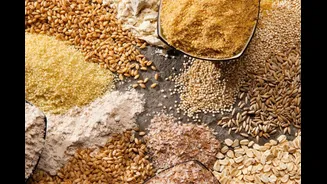









A recent study by the Council on Energy, Environment and Water (CEEW) has spotlighted a troubling and fundamental shift in India’s dietary landscape: nearly half of the protein consumed by Indians at home
now originates from cereals such as rice, wheat, suji, and maida. This finding, based on the latest 2023-24 National Sample Survey Office (NSSO) Household Consumption Expenditure Survey, exposes a “silent crisis” where the quantity of protein masks a serious deficiency in its quality.
The analysis reveals that while the average Indian appears to meet the daily protein quantity requirement, clocking about 55.6 grams a day, the overwhelming reliance on cereals is a major red flag. Cereals contribute close to 50 per cent of total protein intake, a figure that is significantly higher than the 32 per cent recommended by the Indian Council of Medical Research–National Institute of Nutrition (ICMR-NIN).
The Quality Deficit
The core issue lies in the poor quality and low bioavailability of cereal-based protein. Unlike pulses, milk, eggs, and meat, which offer a complete profile of essential amino acids, most plant proteins found in cereals often lack one or more of these crucial building blocks.
This means that the body struggles to fully utilise the protein consumed, potentially leading to deficiencies despite seemingly adequate intake figures. This imbalance effectively crowds out higher-quality protein sources, creating a nutritional gap. Pulses, traditionally a staple source of protein, now account for only 11 per cent of the total protein intake, falling significantly short of the recommended 19 per cent.
Inequality Drives the Imbalance
The CEEW study also highlighted stark socio-economic inequality in protein consumption. The reliance on cheap, government-subsidised cereals like rice and wheat, often distributed through the Public Distribution System (PDS), is far more pronounced in lower-expenditure groups. The analysis found that the richest 10 per cent of Indians consume approximately 1.5 times more at-home protein than the poorest 10 per cent.
The disparity is particularly stark for animal-based protein sources, which offer superior quality. For instance, the poorest rural households meet only 38 per cent of the recommended daily allowance for eggs, fish, and meat, while the wealthiest exceed the recommendation at 123 per cent. This pattern underscores that the nutritional transition—or lack thereof—is deeply unequal, reinforcing a diet dominated by low-quality carbohydrates and high caloric loads from cereals and cooking oils.
To address this deepening public health challenge, the report recommends systemic reforms across public food programmes to shift provisioning away from being cereal-dominant, expanding access to nutrient-dense foods such as coarse grains, pulses, and milk.