
One of the key references Sharjeel Imam made in his 2020 speech which landed him in all sorts of trouble – and rightly so – was to the growing Muslim population in the Chicken’s Neck Corridor, which, he stated,
could be harnessed to engineer an insurrection to cut it off from India’s mainland, thus wresting the North East away from the rest of the country. The overt threat that Imam – implicated also in the Delhi riots case – made no longer remains a polemical or rhetorical mention, particularly with regard to the demographic inversion taking place across several districts of West Bengal.
The demographic shifts at the district level in India’s most densely populated state are more pronounced and perhaps irreversible in areas along the international border with Bangladesh. Border districts such as Murshidabad, Malda, North 24 Parganas, and Uttar Dinajpur have witnessed momentous changes over recent decades, with Murshidabad now recording a Muslim majority over the Hindus – well above 60 per cent according to census and demographic estimates – representing a marked, rather worrisome, reversal from earlier periods.
Malda too was recorded as a Muslim majority district in the 2011 census, with more than half the district’s population belonging to the said community. Further, North 24 Parganas and Uttar Dinajpur, which previously did not have overwhelming majorities, show substantially increased Muslim population shares and rapid growth compared to previously recorded, historical figures.
Should these numbers bother us? The answer is a resounding yes. As these are not mere numbers, they might well seal the fate of West Bengal to begin with extending to the rest of the country if left unchecked. It might be worth arguing that what we might ignore today as a theoretical premise may well turn out to define a grim future, one that elates the hearts of those living to see the day when Ghazwa-e-Hind becomes a reality. In other words, demographic inversion is nothing short of population jihad.
What could not be accomplished by swords, firepower, and wars, is being surreptitiously set in motion through significant increase in the proportion of the community, leading to new majority-minority configurations in places where the historical balance was altogether different. The foremost cause of the fearsome state of affairs in several districts of West Bengal remains the porous and extensive Indo-Bangladesh border which has long been a corridor for both refugee movements (especially around the 1947 Partition and 1971 Liberation War) and ongoing cross-border migration of illegal and undocumented Bangladeshi Muslims.
While official Indian census data captures legal residents, there are longstanding debates about undocumented migration influencing demographic patterns in border areas. The recently released SIR figures brought the focus back to the worrying pattern of illegal migrants acquiring legal Indian documents like Aadhar Card and Voter ID Card through illegal means. In fact, a number of illegal Bangladeshi squatters in UP and Bihar described in detail—to several media outlets—how they found extensive help in the form of an entire chain of people involved in fortifying their existence in India as legal citizens.
Of course, the farce unravels as soon as one starts to scratch the surface—mini madrasas start to tumble out of slums occupied by illegal Bangladeshi settlers, replete with religious texts in Arabic and Urdu, while some are unable to satisfactorily respond to how the person listed as their father is younger to them by 10 years!
Over the decades, many would argue, variations in fertility rates between communities have contributed to differential population growth patterns. Data from national surveys show that, in West Bengal, fertility rates among Muslims have been relatively higher than among Hindus, contributing to higher natural growth rates in certain areas. However, while growing birth rates is one side of the story, the deliberate incursion of illegal Bangladeshi Muslims to bolster the population figures in border districts and towns cannot be denied.
The electoral advantage this demographic inversion accrues to the ruling Trinamool Congress, the Left, and other non-BJP political formations in West Bengal then only remains a perfunctory assumption. Come election season, the question of demographic inversion in these districts becomes highly volatile, politically and socially. As has been the case in the past as well, discussions around shifting population balances surface during election campaigns—as is already evident in West Bengal with the TMC and BJP trading blows over Muslim appeasement politics—with political leaders and parties framing these changes in competing narratives around cultural identity, resource distribution, and therefore, overall regional development.
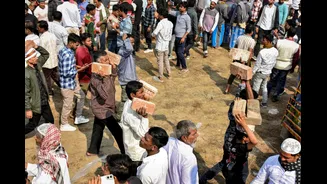
The images beamed across living rooms of the crowds drawn by the announcement by former TMC member Humayun Kabir of building a Babri Masjid—on the lines of the one demolished in Ayodhya—are symptomatic of a deeper, more insidious problem. Besides the claims and counter-claims by political parties during election season, a long-drawn, extended, and thus highly problematic process of demographic inversion appears to be at play in West Bengal with profound implications for national security.
While demographic change in itself might not be immediately or inherently destabilising, its interaction with geography, capacity for governance, and regional geopolitics renders West Bengal strategically sensitive and susceptible to cross-border terrorism. From a national security perspective, border regions are particularly critical spaces where questions of sovereignty, internal stability, and external influence intersect most ubiquitously.
Large-scale demographic changes in these areas raise concerns about undocumented and illegal migration, management or rather mismanagement of borders, and the state’s capacity to regulate movement across a complex riverine and agrarian terrain with visible limitations concerning border fencing and policing. Even limited but continuous inflows can alter local demographics over time, complicating verification, citizenship documentation, and law enforcement, which probably explains the rather frightening situation in West Bengal.
A state government favouring demographic shift to reinforce their Muslim vote bank and weak administrative control in densely populated border districts have created vulnerabilities that are being exploited by transnational criminal networks involved in smuggling, human trafficking, and counterfeit currency operations, all of which have direct security ramifications. From a strategic perspective then, West Bengal’s very location in eastern India—adjacent to the Siliguri Corridor and close to the Bay of Bengal—adds another layer of grave concern to the worsening situation.
Any instability in the state, however minimal, has implications for connectivity to the Northeast and for India’s broader eastern security architecture, exactly what Sharjeel Imam was referring to in his speech at the Shaheen Bagh sit in; exactly why he is considered a national security hazard and a seditious hatemonger endangering the sovereignty of the state. Combine demographic stress with economic underdevelopment and weak border governance and one has a potentially precipitous problem at hand, one that could complicate, even compromise, counter-insurgency coordination, intelligence gathering, and even disaster response in the region.
Any strategy to counter-balance the demographic inversion in West Bengal would remain predicated on transition in political power from forces that actively participate in the process of large-scale population shifts to those that work towards preventing illegal migration, considering it one of the greatest threats to India’s internal security. The swift decimation of all semblances of democracy across the border in Bangladesh, the gratuitous rise of Islamism as a result of the breaking down of the Bengali consensus which actually created the nation in the first place, and their growing closeness to co-religionists and former cultural colonisers—Pakistan—is not making matters any better for West Bengal and India.
Dr Roshni Sengupta is an author, political commentator, and professor of politics and media at IILM University Gurugram. The views expressed in this article are hers and do not reflect those of the institution. Views expressed in the above piece are personal and solely those of the author. They do not necessarily reflect News18’s views.