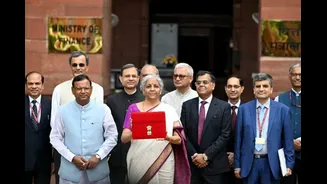








Budget 2026 Expectations: Industry leaders have urged the government to sharply step up infrastructure spending in the forthcoming Union Budget, pitching for a doubling of allocations to Rs 3 lakh crore
to accelerate economic growth, job creation, and competitiveness.
Ahead of the Budget, leaders from sectors ranging from logistics and real estate to renewable energy and data infrastructure have called for bold reforms and higher capital outlay, according to a statement by the Logistics Sector Skill Council (LSC).
Building on last year’s Rs 1.5 lakh crore allocation of interest-free loans to states, along with landmark investments in highways, urban transport, and smart cities, expectations are running high for a potential doubling of this outlay, the statement said.
A recent LSC survey underlined the need for an infrastructure-centric Budget aligned with India’s ambition to emerge as a global economic powerhouse.
Logistics, supply chains at the core
Ravikanth Yamarthy, CEO of the Logistics Sector Skill Council, said Budget 2026 comes at a crucial juncture for the sector. “As the logistics sector emerges as the engine of India’s economic momentum, Budget 2026 presents a defining opportunity to set new benchmarks in growth, employment generation, and Atmanirbhar Bharat.”
He added that the prospect of doubling infrastructure allocations, following years of transformative investment in highways, railways, and logistics corridors, could unlock stronger supply-chain efficiency and boost India’s global competitiveness.
Industry leaders broadly stressed that sustained and predictable infrastructure planning is essential to attract investment, enhance competitiveness, and ensure balanced regional development.
Consumption, retail, and logistics linkages
Shrenik Ghodawat, Managing Director of the Sanjay Ghodawat Group, said infrastructure remains the key trigger for the next phase of consumption growth. “We see a significant opportunity for the Budget to prioritise retail-centric infrastructure, specifically by encouraging investments in modern warehousing, cold-chain facilities, and last-mile logistics corridors.”
Energy transition and digital infrastructure
From the clean energy space, Avishek Kumar, Founder and Director of Sunkonnect, called for deeper investment across the solar value chain. “We need serious investment in decentralised solar, microgrids. At the same time, we must build recycling and R&D ecosystems for solar panels and batteries, while prioritising local battery manufacturing and a domestic supply chain for energy storage systems.”
Technology-led infrastructure was another key theme. Gagan Arora, Founder and President of Vertex Group, said, “We expect major investment in world-class data centres, affordable power tariffs for these facilities, and tax breaks for companies building advanced computing networks and AI hardware.”
Hospitality, urbanisation, and real estate expectations
From the hospitality sector, Manbeer Choudhary, CMD of Noormahal Group, urged the government to prioritise comprehensive infrastructure upgrades to support tourism-led growth.
Real estate leaders, meanwhile, said Budget 2026 could be pivotal for Tier 2 and Tier 3 cities. Rajesh Damani, Founder and Managing Director of Jamshri Realty Ltd, said: “The upcoming Union Budget 2026 is expected to be a watershed moment for Tier 2 and Tier 3 cities… Increased capital expenditure on regional connectivity, such as ring roads and metro extensions, will unlock new growth corridors.”
Damani also called for a revision in the affordable housing price cap.
“Raising this limit to Rs 75 lakh or Rs 80 lakh would reflect the current land and construction costs in growing cities and allow more families in Tier 2 markets to access credit-linked subsidies and tax benefits,” he added.
Bhupindra Singh, COO of RISE Infraventures, said policy frameworks need to catch up with changing buyer behaviour. “Revisiting income thresholds, home loan deductions and capital gains taxation is critical to restoring affordability and rebuilding buyer confidence.”
He also called for higher housing loan deductions under Section 80C and a calibrated interest-rate environment to support demand without fuelling speculation.
Pankaj Jain, Founder and Chairman of SPJ Group, said the sector expects a combination of infrastructure investment and stable, forward-looking policies. “Measures such as industry status for real estate, streamlined approvals, and a more predictable operating environment can significantly strengthen the business ecosystem for the organized retail class,” he added.
Faster approvals, policy clarity
Ashwani Kumar of Pyramid Infratech highlighted execution challenges.
“Timely execution has become the defining factor for real estate growth today, and Budget 2026 must address the policy bottlenecks that slow it down,” he said.
He reiterated the long-standing demand for a single-window clearance system and tax relief for homebuyers, arguing that faster approvals and predictable taxation would improve project viability and restore buyer confidence.
With unified calls from logistics, energy, technology, hospitality, and real estate, stakeholders see Budget 2026 as a pivotal opportunity to lay the foundation for inclusive, infrastructure-led growth, driven by higher capital spending, structural reforms, and long-term policy clarity.