


The rapid expansion of high-altitude lakes in Arunachal Pradesh is raising concerns over the growing risk of glacial lake outburst floods (GLOFs), with a new study identifying two lakes in the state as
being at high risk and another 36 as medium-risk.
The study, published in Discover Hazards, assessed 127 lakes across Arunachal Pradesh. Of these, 89 were classified as low-risk, 36 as medium-risk and two as high-risk. The medium- and high-risk lakes are concentrated in Upper Dibang Valley, West Kameng and Tawang, areas that are important for downstream settlements as well as hydropower infrastructure.
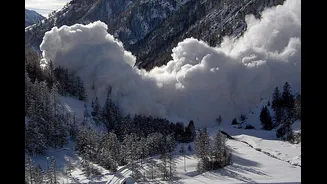
A GLOF occurs when water stored in a glacial or high-altitude lake is suddenly released, often because of the failure of a natural moraine dam. Such an event can send large quantities of water, rocks, sediment and debris downstream, potentially causing destruction far beyond the lake itself.
Lake Numbers, Areas Rise Over Three Decades
Using multitemporal satellite data, researchers found a significant rise in both the number and total area of lakes in Arunachal Pradesh between 1988 and 2020.
The state had 1,487 mapped lakes covering 7,921.95 hectares in 1988. By 2020, the number had increased to 1,985, while their combined area had grown to 11,134.51 hectares.
The sharpest growth was recorded among non-glacial lakes. Their number increased by 498, while their combined area expanded by 3,212.56 hectares.
The study also found different trends among glacial lake categories.
Proglacial lakes (PGLs), which are directly connected to glaciers, declined slightly in number but increased in area. There were 24 such lakes covering 110.72 hectares in 1988. By 2020, their number had dropped to 22, while their total area rose to 125.93 hectares.
Unconnected glacial lakes (UGLs), meanwhile, increased in number but decreased in total area. Their number rose from 136 in 1988 to 205 in 2020, while their combined area fell from 1,363.96 hectares to 1,215.57 hectares.
Most of the newly formed lakes were located between 4,000 metres and 5,000 metres above mean sea level, highlighting changes in the higher reaches of the eastern Himalayas.
Glacier Retreat Raises GLOF Concerns
For its GLOF assessment, the research team selected 127 lakes and used the Analytic Hierarchy Process (AHP) to rank their risk based on multiple parameters.
The rate at which a lake is expanding and its proximity to glaciers emerged as the most important factors in determining GLOF risk.
Researchers linked the expansion of glacial lakes to rising temperatures, glacier retreat and climate change. As glaciers melt, new lakes can form while existing ones may expand, increasing the potential for GLOFs downstream.
“Many rivers originate from these high-altitude basins and feed the Brahmaputra River,” the study said, warning that even a moderate GLOF could travel considerable distances downstream and worsen flooding through heavy sediment loading and channel instability.
The study called for continuous monitoring, updated hazard assessments and stronger preparedness measures, including early-warning systems, community awareness programmes and protection of critical infrastructure.
‘There Is A Risk Of Speedy Water Level Rise’
Nabajit Hazarika of Cotton University, one of the researchers, said a Nepal-like devastation in Arunachal Pradesh or other downstream areas is unlikely because settlements are located at considerable distances from the identified high-risk lakes.
However, he cautioned that the impact of a GLOF cannot be assessed solely by measuring the distance between a lake and a settlement.
“The impact of a GLOF depends on how far the materials, runoff, water and sediment travel before eventually spreading in the valley and waning off,” Hazarika said, adding, “Of course, there is a risk of speedy water level rise in downstream areas.”
Hazarika also stressed that the findings should be viewed as an estimate rather than a definitive assessment of GLOF risk across the eastern Himalayas. He said there could be other potentially dangerous lakes that have not yet been assessed.
The other researchers involved in the study were Vimha Ritse, Amenuo Susan Kulnu and Latonglila Jamir of Nagaland University.