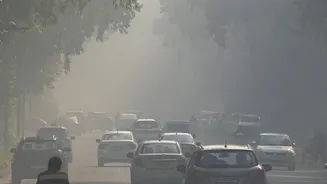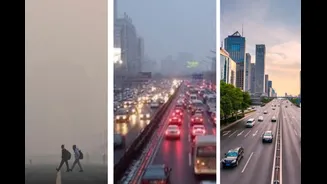










Every year, as the mercury dips, Delhi braces for its fight with air pollution. With various levels of curbs and precautions, the capital city gets temporary respite, only for the battle to resume in months.
But there is one country that has managed to win this fight – China. How did China do it? Can the model be adopted for Delhi? News18 explains
Key steps in China’s fight against air pollution
The spokesperson for the Chinese embassy in India, Yu Jing, has been sharing tips on how Beijingfought a battle similar to New Delhi.
STEP 1: Jing said vehicle emissions control was key. She listed the measures that could be replicated.
- Adopt ultra-strict regulations like China 6NI (on par with Euro 6)
- Phase-out retired old, high-emission vehicles
- Curb car growth via license-plate lotteries and odd-even / weekday driving rules
- Build one of the world’s largest metro and bus networks
- Accelerate the shift to electric mobility
- Work with the Beijing-Tianjin-Hebei region on coordinated emissions cuts.
How did Beijing tackle air pollution? 🌏💨
Step 1: Vehicle emissions control 🚗⚡
🔹 Adopt ultra-strict regulations like China 6NI (on par with Euro 6)
🔹 Phase-out retired old, high-emission vehicles
🔹 Curb car growth via license-plate lotteries and odd-even / weekday driving… pic.twitter.com/E0cFp4wgsV— Yu Jing (@ChinaSpox_India) December 16, 2025
STEP 2: Jing said industrial restructuring is key to the fight. She elaborated on how China did it.
- Shut down or remove 3000+ heavy industries. Relocating Shougang, one of China’s largest steelmakers, alone cut inhalable particles by -20%.
- Transform vacated factories into parks, commercial zones, cultural and tech hubs. E.g. The former Shougang site became 2022 Winter Olympics venue.
- Relieve non-capital functions by relocating wholesale markets, logistics hubs and some educational & medical institutions.
- Coordinate regional integration by shifting general manufacturing to Hebei, while retaining high-value R&D and services in Beijing.
How does Beijing tackle air pollution? 🌫️➡️🌱
Step 2: Industrial Restructuring
🔧 Shut down or remove 3000+ heavy industries. Relocating Shougang, one of China’s largest steelmakers, alone cut inhalable particles by -20%.
🏭➡️🏞️ Transform vacated factories into parks,… pic.twitter.com/SYPOsoMaO1
— Yu Jing (@ChinaSpox_India) December 17, 2025
In November, too, Ying had outlined key policies that helped Chinese cities achieve some of the fastest improvements in air quality globally. She had said shutting down of small and inefficient coal boilers, relocating or closing highly polluting industrial plants, enforcing stricter emission standards for heavy industries and vehicles helped.
She also stressed on expansion of renewable energy sources such as wind, solar, and hydropower, using satellite data and real-time monitoring systems to track air quality, strictly punishing non-compliance and data falsification.
“Both China and India know the struggle with air pollution amid rapid urbanization. While the challenge remains complex, China’s sustained efforts over the past decade have delivered noticeable improvements,” Yu wrote in a recent post on X.
Both China and India know the struggle with air pollution amid rapid urbanization 🌫️📊.
🌫️➡️🌤️ While the challenge remains complex, China’s sustained efforts over the past decade have delivered noticeable improvements.
📌 In the coming days, we’ll share a bite-sized series… pic.twitter.com/0ZG4Rl8ISD
— Yu Jing (@ChinaSpox_India) December 15, 2025
Delhi AQI very poor on Wednesday
Delhi witnessed a slight improvement in air quality on Wednesday morning, with the overall Air Quality Index (AQI) recorded at 328 at around 8 am, keeping it in the‘very poor’ category, according to data from the Central Pollution Control Board (CPCB).
The air quality improved slightly compared to Tuesday, as the AQI was 354 at 4 pm. However, large parts of the city remained enveloped in toxic smog, and the overall air quality continues to be poor.
Anand Vihar was shrouded in thick smog, with an AQI of 341, placing it in the ‘very poor’ category. A thick layer of smog also engulfed areas around IGI Airport, ITO, Dhaula Kuan, AIIMS and the Ghazipur National Highway 24.
According to CPCB data, several areas in the capital, including Bawana (376), ITO (360), Jawaharlal Nehru Stadium (324), and Narela (342), continued to experience poor air quality, placing them in the ‘very poor’ category. Wazirpur also recorded poor air quality, with an AQI of 359.
However, many areas in Delhi showed slight variations in air quality on Wednesday morning. For instance, Burari Crossing recorded an AQI of 298 (Poor), which is relatively better than other locations in the city. Other areas, such as IGI Airport Terminal 3 (263), IIT Delhi (300), and CRRI Mathura Road (297), also recorded improved air quality but remained in the ‘poor’ category.
According to CPCB categorisation, 0-50 is ‘good’, 51-100 ‘satisfactory’, 101-200 ‘moderate’, 201-300 ‘poor’, 301-400 ‘very poor’, and 401-500 ‘severe’.
Earlier, Delhi Environment Minister Manjinder Singh Sirsa announced strict measures to curb vehicular pollution in the national capital. The minister stated that starting December 18, vehicles without a valid Pollution Under Control Certificate (PUCC) will not be supplied fuel at petrol pumps in Delhi, according to an official release.
With agency inputs