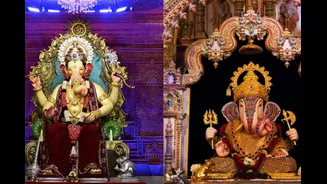




Ganesh Chaturthi 2026 Celebrations: Ganesh Chaturthi is among India’s most vibrant Hindu festivals, celebrating the birth of Lord Ganesha, the deity associated with wisdom, prosperity and the removal of obstacles.
While the festival is observed across the country, its rituals, names, food, music and community traditions differ from state to state.
In 2026, Ganesh Chaturthi will be celebrated on Monday, September 14. From Maharashtra’s spectacular public pandals and processions to Goa’s intimate Chovoth traditions, Karnataka’s Gowri-Ganesha observance, Andhra Pradesh’s Vinayaka Chavithi and Tamil Nadu’s Vinayagar Chaturthi, each region gives the festival its own distinctive character.
Ganesh Chaturthi 2026 Date and Puja Muhurat
Ganesh Chaturthi 2026 will be observed on Monday, September 14. The festival falls on the Chaturthi tithi of Shukla Paksha in the Hindu month of Bhadrapada and marks the birth of Lord Ganesha.
- Chaturthi Tithi begins: 7:06 AM on September 14, 2026
- Chaturthi Tithi ends: 7:44 AM on September 15, 2026
- Madhyahna Ganesha Puja Muhurat: 11:02 AM to 1:31 PM
- Puja duration: 2 hours 28 minutes
- Ganesh Visarjan: September 25, 2026, for the 10-day observance
The Madhyahna period is considered especially significant for Ganesh Puja because traditional belief associates Lord Ganesha’s birth with midday. Current 2026 calendar data also confirms September 14 as Ganesh Chaturthi, with the Chaturthi tithi running from September 14 into September 15.
Ganesh Chaturthi 2026: Moon Sighting Restriction
A traditional belief associated with Ganesh Chaturthi is that devotees should avoid sighting the Moon during a specified period on Chaturthi. This is linked to the belief surrounding Mithya Dosha or Mithya Kalank, which is associated with false accusations or undeserved blame.
- Time to avoid moon sighting: 9:01 AM to 8:08 PM
- Duration: 11 hours 08 minutes
Why Ganesh Chaturthi Looks Different Across India
The core ritual remains the same: devotees welcome Lord Ganesha, install an idol, perform prayers and offer traditional food before eventually immersing the idol.
But the way communities experience the festival can be dramatically different.
In Maharashtra, Ganesh Chaturthi has evolved into a huge public and cultural celebration.
In Goa, the festival is deeply connected to family traditions and local Konkani culture.
Karnataka combines Ganesha worship with the preceding Gowri Habba, while Andhra Pradesh celebrates Vinayaka Chavithi with temple rituals and community festivities.
Tamil Nadu gives the festival its own identity through Vinayagar worship and the much-loved kozhukattai.
Here is how the five states celebrate Ganesh Chaturthi differently:
Maharashtra
From Home Ganpati To Massive Public Ganeshotsav
If one state is most closely associated with the modern public celebration of Ganesh Chaturthi, it is Maharashtra.
The festival here is widely known as Ganeshotsav and is celebrated in homes, housing societies, neighbourhoods and enormous public pandals. Maharashtra Tourism describes the festival as not only a religious celebration but also an occasion associated with unity, culture and community participation.
The public tradition gained particular prominence under Lokmanya Bal Gangadhar Tilak, who helped transform Ganesh Chaturthi into a large-scale public festival in the late 19th century. The idea encouraged people from different communities and social backgrounds to gather around a shared cultural celebration.
Today, cities such as Mumbai and Pune become synonymous with grand Ganpati celebrations.
Mumbai’s famous public mandals attract devotees with elaborately decorated pandals and large idols, while neighbourhood celebrations range from modest community installations to some of the city’s most iconic attractions.
The atmosphere is marked by dhol-tasha performances, aartis, cultural programmes and processions, with devotees chanting traditional Ganpati slogans.
Pune has its own distinctive tradition through its historic Ganpati mandals and the city’s famous Dagdusheth Halwai Ganpati. The festival combines religious devotion with Maharashtra’s music, theatre, art and public culture.
Another important feature of Maharashtra’s celebrations is the growing emphasis on eco-friendly Ganpati idols, including clay idols and natural colours, as communities seek to reduce the environmental impact of immersion. Maharashtra Tourism also highlights the state’s increasing focus on environmentally conscious celebrations.
What makes Maharashtra different?
The scale. Ganesh Chaturthi here can transform entire neighbourhoods and cities into giant public festival spaces, blending devotion, art, music and community participation.
Goa
Chovoth Is More Intimate and Rooted in Konkani Traditions
In Goa, Ganesh Chaturthi is popularly known as Chovoth and is among the state’s most important festivals.
Unlike Maharashtra’s highly public-facing Ganeshotsav, traditional Goan celebrations have a strong emphasis on the family home.
Goa Tourism notes that a clay Ganapati idol is brought home, while a traditional matov, or temporary canopy above the place where the idol is installed, is decorated with natural materials including betel nut, coconut, banana and mango branches.
The festival is also closely associated with the worship of Gauri, Mahadev and Ganapati in traditional households.
For many Goan families, Chovoth is a time for relatives to return home, making the festival as much about family reunion and ancestral traditions as it is about the central puja.
Food is another major part of the celebration.
Traditional Goan festive dishes include Nevri, a sweet preparation similar to karanji, and Patoleo, a steamed rice preparation made with coconut and jaggery and cooked in turmeric leaves.
Goa Tourism identifies Nevri as a popular preparation during Ganesh Chaturthi, while Patoleo is another traditional Goan sweet associated with the monsoon season.
Goan festival cuisine can extend well beyond sweets, with traditional vegetarian dishes prepared for family gatherings.
In many places, the idol is immersed after a relatively short celebration. Goa Tourism notes that the minimum traditional observance is at least one and a half days, with immersion taking place in a water body such as the sea, river, creek, lake or well.
What makes Goa different?
The emphasis on family, homecoming, Konkani traditions, local food and intimate household rituals gives Goan Chovoth a distinct character.
Karnataka: Ganesh Chaturthi Comes After Gowri Habba
In Karnataka, Ganesh Chaturthi is commonly associated with Ganesha Habba or Gowri-Ganesha Habba.
One of the biggest differences here is that the festival is preceded by Gowri Habba, dedicated to Goddess Gowri, the mother of Lord Ganesha.
Karnataka Tourism states that Gowri Habba is celebrated one day before Ganesha Chaturthi, with the two festivals together often referred to as Gowri Ganesha Habba.
Gowri Habba traditionally has a strong role for women. A Gowri idol is installed and decorated, while women participate in prayers and exchange bagina, a collection of traditional items such as turmeric, vermilion, bangles, grains, coconut and sweets.
The following day belongs to Ganesha.
Homes, temples and community spaces across Karnataka install Ganesha idols and conduct pujas, aartis and cultural programmes.
Bengaluru, in particular, sees decorated idols and community celebrations across neighbourhoods. Karnataka Tourism describes Ganesha Utsava as one of the state’s major festivals, highlighting its combination of traditional worship, cultural programmes and community spirit.
Food is also central to the festival, with regional households preparing sweets and savoury offerings associated with Ganesha worship.
What makes Karnataka different?
The defining feature is the Gowri-Ganesha sequence: Goddess Gowri is welcomed first, followed by Ganesha. This gives the celebration a distinctive two-day devotional rhythm.
Andhra Pradesh: Vinayaka Chavithi and Temple-Centred Devotion
In Andhra Pradesh, Ganesh Chaturthi is widely known as Vinayaka Chavithi.
Devotees install Ganesha idols at homes, temples and community spaces, perform pujas and participate in devotional programmes. Temple traditions are particularly important in the state.
One of the best-known Ganesha pilgrimage centres is Kanipakam, home to the Sri Varasiddhi Vinayaka Swamy Temple. Andhra Pradesh Tourism describes the temple’s presiding deity as a self-manifested Varasiddhi Vinayaka and notes that the annual Vinayaka Swamy Brahmotsavams are held around Vinayaka Chaturthi.
The temple’s traditions give the festival a distinctive pilgrimage dimension in Andhra Pradesh.
At Tirupati, Vinayaka Chavithi is also marked by special temple rituals. TTD records celebrations involving abhishekam, archana, special pujas and a procession of Lord Vinayaka on the Mooshika vahana at the Sri Kapileswara Swamy Temple.
Alongside temple observances, households prepare traditional offerings and participate in local community celebrations.
Hyderabad, although geographically in Telangana, is also famous for its enormous public Ganesh celebrations and immersion processions. However, for Andhra Pradesh, the emphasis around places such as Kanipakam adds a strong temple and pilgrimage-oriented dimension to Vinayaka Chavithi.
What makes Andhra Pradesh different?
The combination of home worship, community celebrations and major temple traditions, particularly the prominence of Kanipakam’s Varasiddhi Vinayaka, gives Vinayaka Chavithi a strong pilgrimage identity.
Tamil Nadu: Vinayagar Chaturthi and the Popular Kozhukattai
In Tamil Nadu, Ganesh Chaturthi is widely called Vinayagar Chaturthi or Pillayar Chaturthi.
The festival is observed in homes, temples and public spaces, with devotees installing clay idols, performing pujas and offering traditional food to Lord Ganesha.
Tamil Nadu Tourism notes that celebrations include clay idols, special pujas, processions and idol immersion. The state also has important Ganesha temples, including Pillayarpatti Karpaga Vinayagar Temple and the Uchi Pillayar Temple in Tiruchirappalli.
But one of the most recognisable Tamil Nadu traditions is the prominence of kozhukattai.
The steamed rice-flour dumpling, generally filled with coconut and jaggery, is closely associated with Vinayagar Chaturthi and is offered as prasadam. Tamil Nadu Tourism describes kozhukattai as one of the traditional preparations most strongly linked with the festival in the state.
The festival therefore has a distinctly Tamil culinary identity alongside its religious rituals.
Temples such as Pillayarpatti and Uchi Pillayar also become important destinations for devotees during the season.
What makes Tamil Nadu different?
The festival’s distinctive identity comes from Vinayagar worship, major Ganesha temples and the central place of kozhukattai in household offerings and celebrations.
One Festival, Many Regional Traditions
Ganesh Chaturthi may have the same central spiritual meaning across India, but its expression changes dramatically with geography and culture.
- In Maharashtra, the festival becomes a public spectacle that brings entire neighbourhoods together.
- Goa turns it into a deeply rooted family celebration shaped by Konkani food and customs.
- Karnataka places Goddess Gowri at the centre of the celebrations before welcoming Ganesha.
- Andhra Pradesh gives Vinayaka Chavithi a strong temple and pilgrimage dimension, while Tamil Nadu adds its own culinary and temple traditions through Vinayagar worship and kozhukattai.
These differences are what make Ganesh Chaturthi one of India’s most culturally diverse festivals.
The idol may be the same beloved Vighnaharta, but the way devotees welcome him, through music, food, family rituals, temple worship or grand public celebrations, reflects the unique cultural identity of each region.