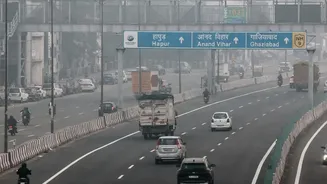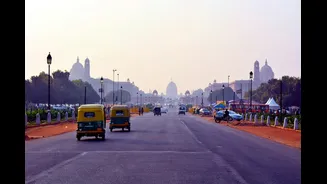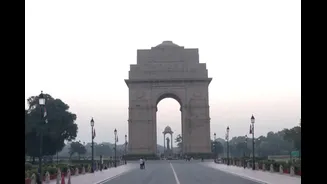







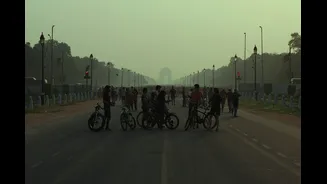
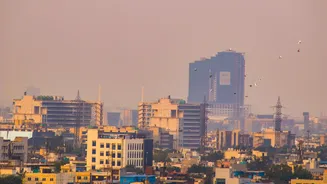
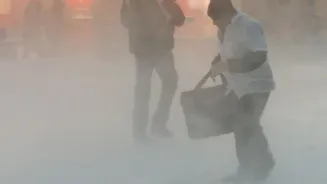
As Diwali approaches, the air quality in the national capital continues to deteriorate, with the Air Quality Index (AQI) around India Gate recorded in the ‘severe’ category.
According to the Central Pollution
Control Board (CPCB), the AQI around India Gate was 414 on Wednesday, placing it in the ‘severe’ category.
#WATCH | Delhi: The Air Quality Index (AQI) in the area around India Gate is at 414, categorised as ‘Severe’, as per the CPCB (Central Pollution Control Board).
(Visuals shot at 06:50 am) https://t.co/gG0UM9P6oc
— ANI (@ANI) November 4, 2026
The AQI around Dhaula Kuan was 417, placing it under the ‘severe’ category and raising serious public health concerns.
#WATCH | Delhi: The Air Quality Index (AQI) in the area around India Gate is at 414, categorised as ‘Severe’, as per the CPCB (Central Pollution Control Board).
(Visuals shot at 06:50 am) https://t.co/gG0UM9P6oc
— ANI (@ANI) November 4, 2026
GRAP-II Invoked Across Delhi
With the air quality worsening in the capital, the Commission for Air Quality Management (CAQM) has invoked Stage 2 of the Graded Response Action Plan (GRAP) across the national capital.
“The Air Quality Index (AQI) of Delhi, which was observed 117 (’Moderate’ Category) on 31.10.2026, has exhibited a sharp rise with AQI of 261 (’Poor’ Category) on 01.11.2026 and has further increased to 324 (’Very Poor’ Category) on 02.11.2026 owing to unfavorable meteorological conditions. ,” the CAQM said in a statement.
With GRAP-2 curbs in place, authorities will intensify measures to mitigate air pollution across the national capital. These measures include regular mechanical road cleaning, water sprinkling, and the use of anti-smog guns to reduce dust.
The latest restrictions followed an expanded set of winter pollution-control measures that came into force on Sunday, November 1. These curbs placed restrictions on the entry and operation of non-BS-VI vehicles registered outside Delhi.
Exemptions were made for CNG and electric vehicles and emergency vehicles.
Delhi’s Winter Election Plan
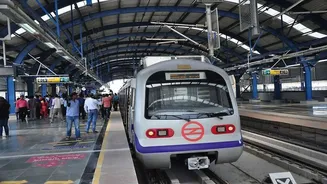
On Sunday, the Delhi Government implemented a winter action plan to curb air pollution in the capital. The measures include promoting public transport to reduce fuel emissions, sprinkling water to control dust, and conducting anti-firecracker awareness campaign.
Under the winter action plan, the ‘No PUC, No Fuel’ rule mandates that vehicles must have a valid Pollution Under Control (PUC) certificate to obtain fuel.